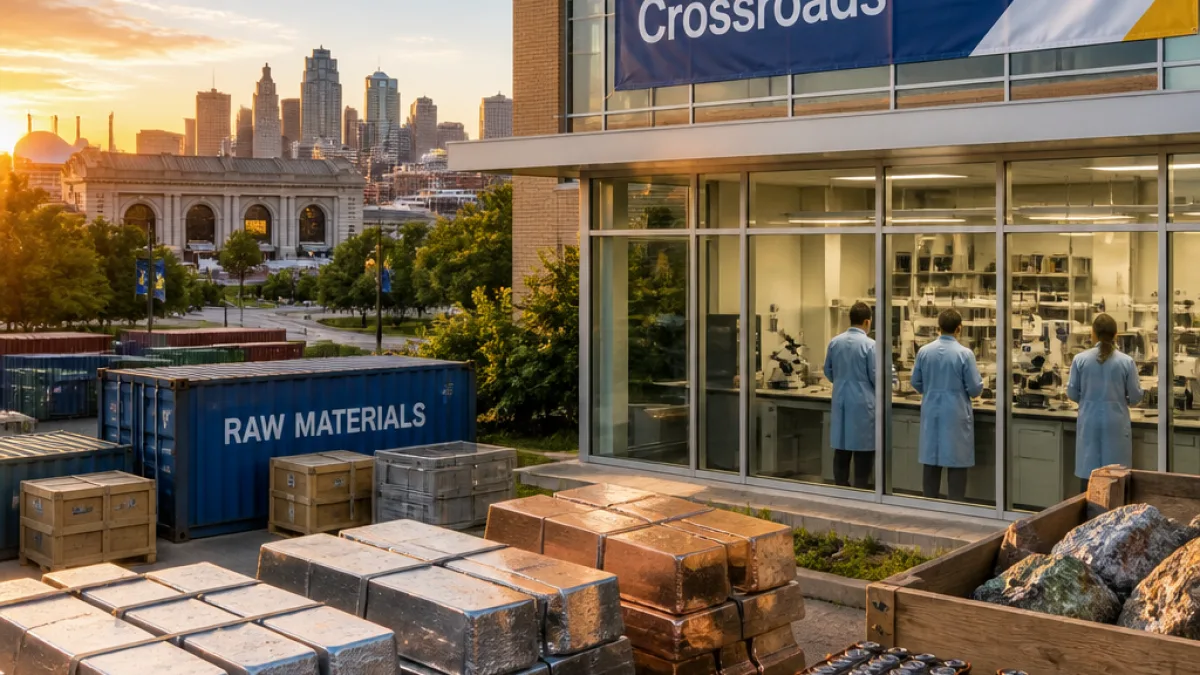
The National Science Foundation has chosen a University of Missouri–Kansas City-led initiative to receive up to $160 million, a potentially historic federal investment that aims to establish the Kansas City region as a national hub for critical materials innovation, manufacturing and workforce development.
Big federal backing for regional supply-chain work
The award funds the NSF Critical Materials Crossroads Engine, a coalition-driven effort launched by the University of Missouri System in 2022. Organizers say the investment could be among the largest in Missouri higher education history and is meant to reduce U.S. reliance on foreign-controlled sources for metals and advanced materials used in batteries, semiconductors, aircraft components and medical devices.
Leaders behind the initiative describe a wide-ranging strategy that spans raw-material recovery, processing, manufacturing scale-up and workforce training. The project brings together a coalition of more than 260 partners from higher education, industry, government and community organizations across Missouri and Kansas.
Economic and workforce projections
Backers estimate the initiative could:
- Create roughly 10,000 jobs by 2036 across manufacturing, R&D, logistics, engineering, construction and training;
- Generate up to $40 billion in economic output over 10 years;
- Increase the combined Missouri-Kansas gross domestic product by about $17 billion during that period.
Those projections, provided by Missouri Extension and members of the coalition, frame the investment as both an economic-development play and a national-security priority: securing domestic chains for materials that power modern technologies.
What this could mean locally
For Kansas City and the broader Missouri-Kansas corridor, the award signals a long-term push to translate research into factories and skilled jobs. Officials say the effort will focus on everything from handling concentrated ore and processing spent materials to developing new manufacturing techniques and training pipelines that feed regional employers.
Local leaders will face the practical work of turning federal grant dollars into facilities, partnerships and curricula. That includes coordinating among universities, community colleges, private companies and labor groups — a complex effort but one that could position the region to capture work tied to electric vehicles, aerospace, microelectronics and medical manufacturing.
| Item | Estimate or detail |
|---|---|
| NSF award (up to) | $160 million |
| Projected jobs by 2036 | ~10,000 |
| Projected economic output (10 years) | $40 billion |
| Projected increase in regional GDP | $17 billion |
The award also highlights a growing federal focus on reshoring key parts of advanced manufacturing and materials processing — a trend Missouri leaders have sought to tap into as the state competes for plants, research centers and federal dollars.
Implementation details, timelines and how funding will be parceled across partners were not fully detailed in the announcement. Still, regional officials and university leaders say this level of NSF support could change the economic landscape by linking research labs, workforce programs and commercial-scale operations.
As the project moves from planning to execution, communities around the state will be watching for announcements on specific facilities, training partnerships and hiring timelines.