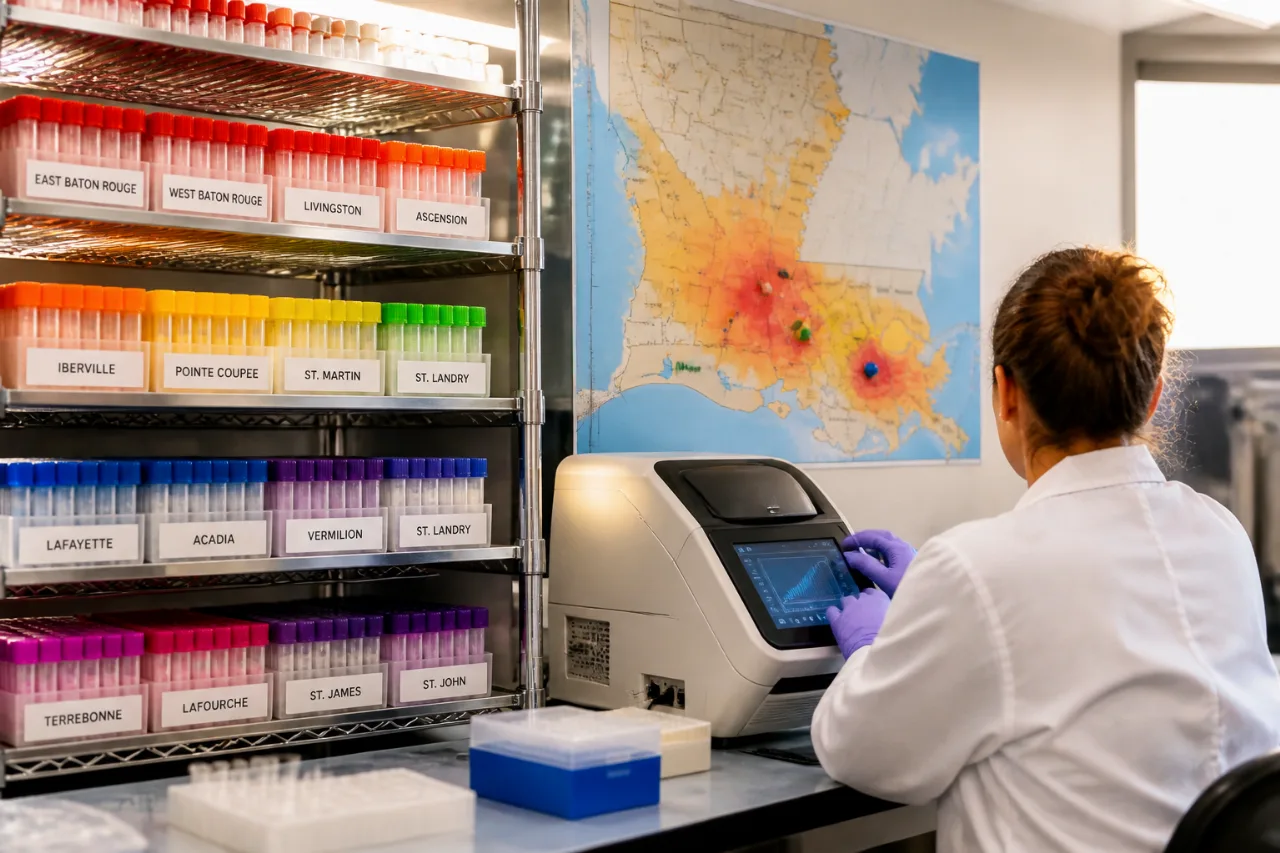
BATON ROUGE — Hundreds of color-coded vials filled with mosquitoes sit frozen on shelves at the Louisiana Animal Disease Diagnostic Laboratory, the hub of the state's mosquito-borne disease surveillance. Each vial, or "pool," represents insects trapped across parishes and sent to Baton Rouge for testing that helps public-health officials spot and respond to viral threats.
How the surveillance system works
Local mosquito control districts across the state gather specimens and ship them weekly to the LSU lab. Technicians process thousands of these pooled samples to detect pathogens that move from animals into humans. The lab director, Alma Roy, said weather is a primary driver of mosquito activity — hotter, wetter conditions mean more breeding and biting, and a greater chance viruses begin to circulate.
“When it’s wet and hot, the mosquito is out there reproducing and biting,”
Lab staff do not test individual insects. Instead they combine up to 100 mosquitoes per vial, grind the collection into a homogenate and run molecular assays that reveal viral genetic material. The test results appear as peaks on a computer readout indicating a positive sample for viruses such as West Nile virus, eastern equine encephalitis or St. Louis encephalitis.
Scale and participation
The diagnostic lab handles a high volume each year. According to the program, technicians examine roughly 25,000 mosquito pools annually, representing as many as 2.5 million individual insects. Participation in the voluntary surveillance network is not universal — about 30 of Louisiana’s 64 parishes send samples each year.
| Metric | Figure |
|---|---|
| Parishes participating (approx.) | 30 of 64 |
| Pools tested per year | 25,000 |
| Individual mosquitoes represented | Up to 2.5 million |
Why the lab matters to Louisianans
The surveillance program plays a practical role: early detection of infected mosquitoes allows health departments and local vector-control teams to target interventions — public warnings, intensified trapping, larviciding or adulticiding in affected areas — before human cases rise. The system links entomologists, parish mosquito control districts and state health officials so that viral activity is monitored across the state.
- Samples are packaged locally and shipped weekly to Baton Rouge.
- Laboratory processing uses a mixing solution and mechanical agitation to prepare samples for molecular assays.
- Positive detections show as distinct spikes on laboratory readouts, signaling which virus is present.
For residents, the takeaway is straightforward: mosquito season intensifies with heat and humidity. Community-level participation in trapping and local control efforts affects how quickly officials can detect and respond to viral circulation. The LSU lab’s work is a behind-the-scenes but essential component of Louisiana’s public-health defenses against mosquito-borne disease.