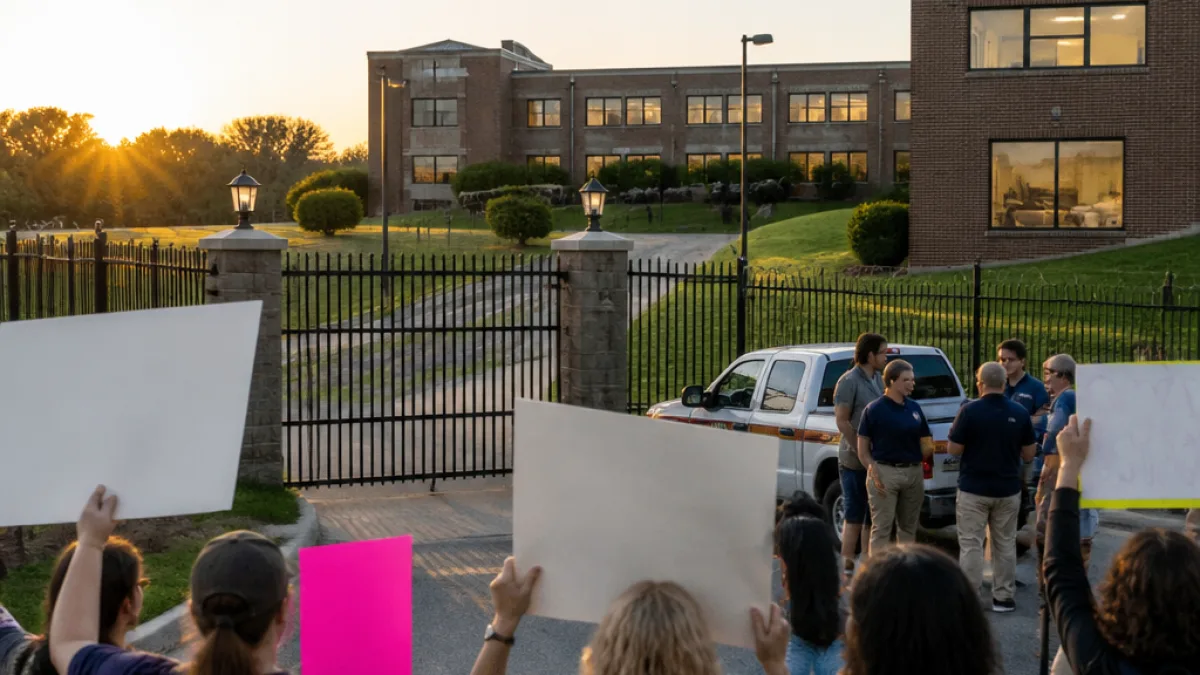
More than a month after the Illinois Department of Human Services announced plans to scale back operations at the state-run Choate Mental Health and Developmental Center in Anna, southern Illinois leaders and workers are intensifying efforts to preserve services they say the region still needs.
What the state plans
On July 23, IDHS outlined a set of changes at Choate that will take effect over the coming months. The department said it will:
- end Choate’s general residential program for people with intellectual and developmental disabilities (I/DD) by Sept. 30,
- phase out all 75 civil mental health beds at the campus by March 2027,
- retain the 40-bed forensic developmental-disabilities program and other state offices on the Choate campus,
- and expand psychiatric capacity at Madden Mental Health Center near Chicago.
The announcement also flagged layoffs and operational changes. The American Federation of State, County and Municipal Employees (AFSCME), which represents most Choate workers, says about 250 of the facility’s roughly 524 employees could lose their jobs.
Local reaction and actions
Community leaders, lawmakers from southern Illinois, health care providers and Choate employees have condemned the plan, saying it will remove services the region still requires. Over recent weeks, advocates have staged protests, marched at the Du Quoin State Fair and used public events to press the state to reverse course.
The debate culminated on Aug. 26 with a town hall at Anna-Jonesboro High School organized by a group of southern Illinois lawmakers. More than 100 people attended to discuss the impact the changes would have on patients, families and staff. Neither Gov. J.B. Pritzker nor a representative from IDHS attended the meeting, despite invitations from local lawmakers.
"This is not a minor change," said state Sen. Paul Jacobs, R-Pomona. "This is a fundamental dismantling of services at a facility that has served so"
The town hall was moderated by state Rep. Patrick Windhorst, R-Metropolis, who said Pritzker and IDHS officials had been invited but did not participate.
Numbers at a glance
| Item | Figure |
|---|---|
| Civil mental health beds to be phased out | 75 |
| Forensic developmental-disabilities beds to remain | 40 |
| Estimated affected employees (AFSCME) | ~250 of 524 |
| Key dates | Sept. 30, 2026 (I/DD units end); March 2027 (civil beds phased out) |
Local impact and unanswered questions
Choate has long served as a central provider for mental health and developmental-disability services in southern Illinois. Advocates at the town hall and recent demonstrations argued the proposed cuts would create gaps in care for patients who lack local alternatives and would deepen workforce losses in a region already facing health care staffing challenges.
State officials, led by the governor, have defended the plan as part of a broader shift away from institutional care toward community-based services and enhanced psychiatric capacity elsewhere in the system. Details about how patients will be transitioned, whether alternative community placements will be available locally, and what support will be provided to displaced workers were central concerns raised by those who attended the town hall.
Until IDHS provides additional implementation details and transitional plans, local officials and service providers say they will continue to press the state for clearer answers and to advocate for expanded services in southern Illinois rather than reductions.
This story will be updated as state officials, Choate representatives or AFSCME provide additional information.