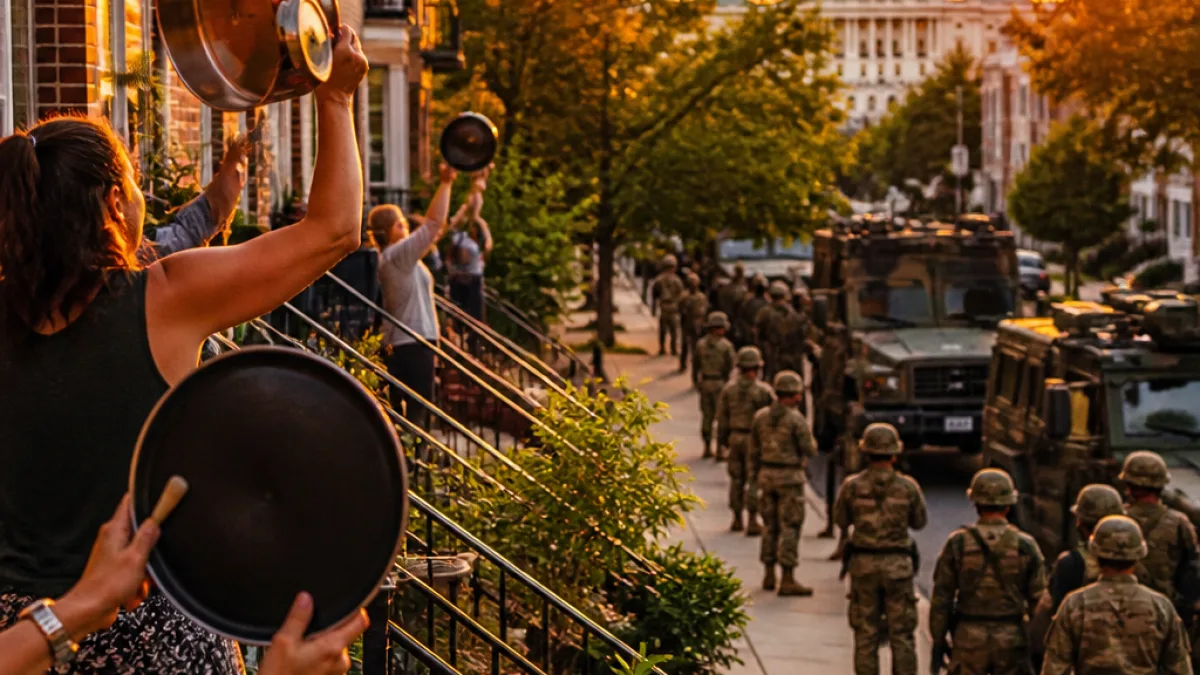
As dusk falls over Lincoln Park, a five-minute chorus of clanging pots and pans has become a regular part of the neighborhood’s soundscape. The ritual — a cacerolazo, a form of protest with roots in 19th-century Europe and Latin America — has been held nearly every night for almost a year by residents of Washington, DC, reacting to a sustained national guard presence across the city.
What residents are hearing and seeing
Many neighbors say the military-style patrols have made the city feel different: uniformed personnel in camouflage and gun holsters at metro stations, parks, tourist sites and on neighborhood streets. The federal deployment began last August under a presidential executive order declaring a crime emergency and was extended this week through January 2029, when the current president’s term ends.
“As long as they’re going to be here, I’m going to be here,”
said Chris Salm, a Lincoln Park resident who participates in the nightly pot-banging. Another longtime neighbor, Mike Licht, who has lived in the District for four decades, described the atmosphere:
“It’s a city under siege. Armed troops aimlessly walking our streets, they’ve got nothing to do, they’re bored.”
Scope of the deployment
City officials and residents have pointed to fluctuating troop levels over the past year:
- For months, roughly 2,000–2,500 national guard troops were reported on patrol across the District.
- In July, that number increased to more than 5,000 during a federal “summer surge” tied to events marking the nation’s 250th birthday.
Local leaders have repeatedly urged a drawdown, but their authority is limited: the District of Columbia is not a state, and while Mayor Muriel Bowser can request National Guard assistance, she does not have sole authority to call up or stand down federally assigned forces.
Local impact and community response
Residents who joined the cacerolazos describe the nightly noise as an act of civic resistance and a way to register discomfort with an extended federal security presence. Protesters say the deployment has not improved public safety and, they contend, may have made some situations more dangerous — a concern they say is backed by recent research.
The continued visibility of troops has also affected routine life in parts of the city: regular walks, commutes and visits to parks and tourist sites now occur alongside heavily uniformed personnel. For some, the presence is reassuring; for others, it is a daily reminder of diminished local control over public safety policy.
Questions for policymakers
The situation raises several governance and civic questions that city residents and officials continue to press:
- How will the District regain control over public-safety decisions while federal forces remain deployed?
- What metrics are being used to evaluate the effectiveness of the prolonged deployment?
- How are impacts on daily life and civil liberties being measured and addressed?
| Item | Reported figure |
|---|---|
| Typical troop presence (months) | 2,000–2,500 |
| Summer surge peak (July) | More than 5,000 |
| Order extended through | January 2029 |
As the deployment continues, neighbors in Lincoln Park and elsewhere say they will keep asserting their presence — one pot-bang at a time — while pressing city and federal officials for answers. Local leaders have few formal levers to end the deployment, so public pressure and continued dialogue between District officials and federal authorities remain central to how the months ahead will unfold.
I will continue to monitor official responses, community actions and any research findings that bear on the deployment’s effect on public safety and life in the District.