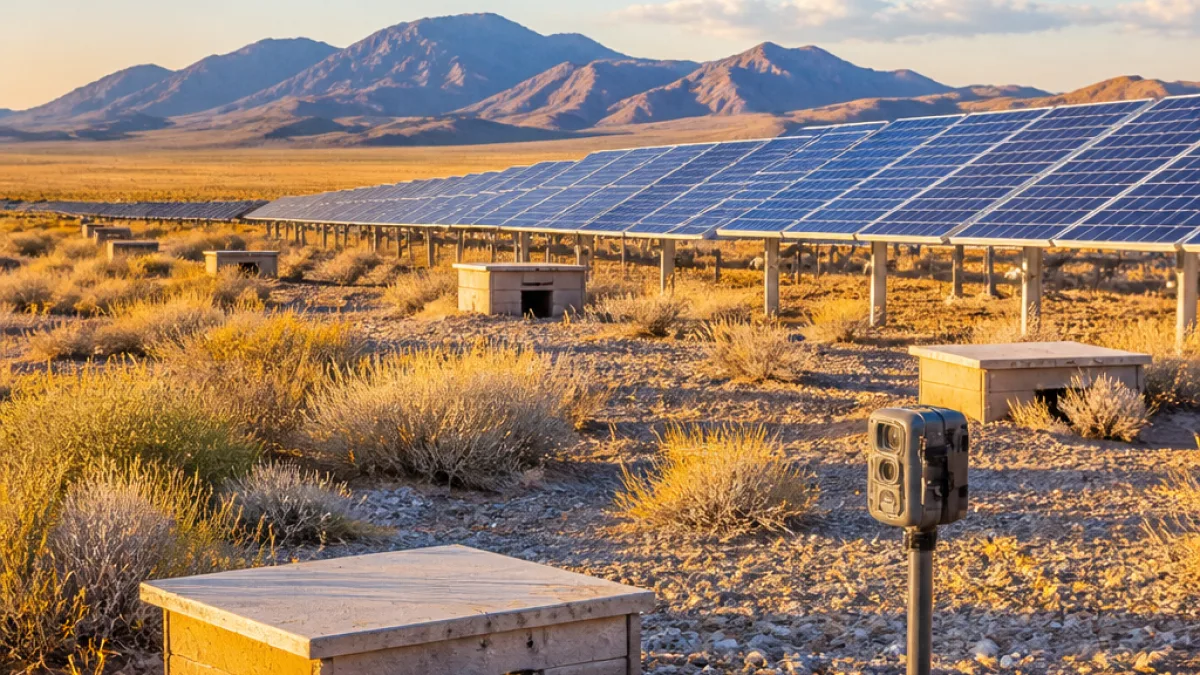
Seventeen miles west of Buckeye, where rows of photovoltaic panels ripple across the desert, a small colony of burrowing owls has taken up residence among the solar arrays. The Sun Streams facility is primarily an electricity producer, but a partnership launched in 2025 has turned part of the site into an active habitat for a species long threatened by development.
Relocation, monitoring and early findings
Last spring, conservation nonprofit Wild at Heart moved burrowing owls displaced by a housing project roughly 50 miles away to the solar site. The relocation included nine breeding pairs and one single male, and managers installed artificial burrows and motion-triggered cameras to track activity.
“We’re still figuring it out,” said Deron Lawrence, vice president of environment at Longroad Energy, reflecting the ongoing study of how the birds adjust to living beside a large-scale solar facility.
Biologists are monitoring nesting success, survival and behavior as the owls adapt to a landscape dominated by panels rather than scrub or trees. Early observations suggest the open, low-profile nature of the solar field may benefit the owls by improving visibility for spotting predators, and panels could even concentrate insects the birds feed on — though researchers caution that conclusions are preliminary.
What the project includes
The Sun Streams effort combines conservation work with academic-style monitoring. Key elements of the initiative include:
- Relocation of displaced owls to the solar site.
- Placement of 30 artificial burrow sites to provide nesting space.
- Use of motion-activated cameras to observe activity around the clock.
- Ongoing tracking of nesting success and survival rates by Wild at Heart and Longroad Energy.
Greg Clark, Wild at Heart’s burrowing owl habitat coordinator, said the program represents nearly three decades of work to protect the species. “When we started investigating burrowing owls in 1999 and 2000, it was clear they were in trouble,” he said, describing the project as a long-term response to that decline.
Why this matters for Arizona
The Sun Streams case is part of a broader conversation in Arizona about how to expand renewable power while limiting harm to wildlife and habitat. As solar development increases across the state, operators and conservationists face questions about siting, mitigation and opportunities for co-existence.
Managers here hope the site will provide a model for how energy projects can include habitat features and active monitoring from the outset. The cameras and data collected will help answer practical questions: Do owls nesting at or near panels have similar breeding success to those in undeveloped areas? Are predation rates different? Does the presence of panels alter prey availability?
| Item | Number |
|---|---|
| Relocated owl pairs | 9 pairs |
| Relocated single males | 1 male |
| Artificial burrow sites | 30 open sites |
| Monitoring | 24/7 motion-activated cameras |
Researchers emphasize that the project does not yet provide definitive answers, but it offers valuable, site-specific data. For communities and policymakers, the work underscores that renewable energy siting need not be a binary choice between power and wildlife — thoughtful design and follow-up can reduce conflicts and, in some cases, create new refuges.
As Arizona continues to build out solar capacity, the Sun Streams experience will be watched closely by developers, conservationists and state agencies looking for practical examples of how to pair clean energy goals with species protection.