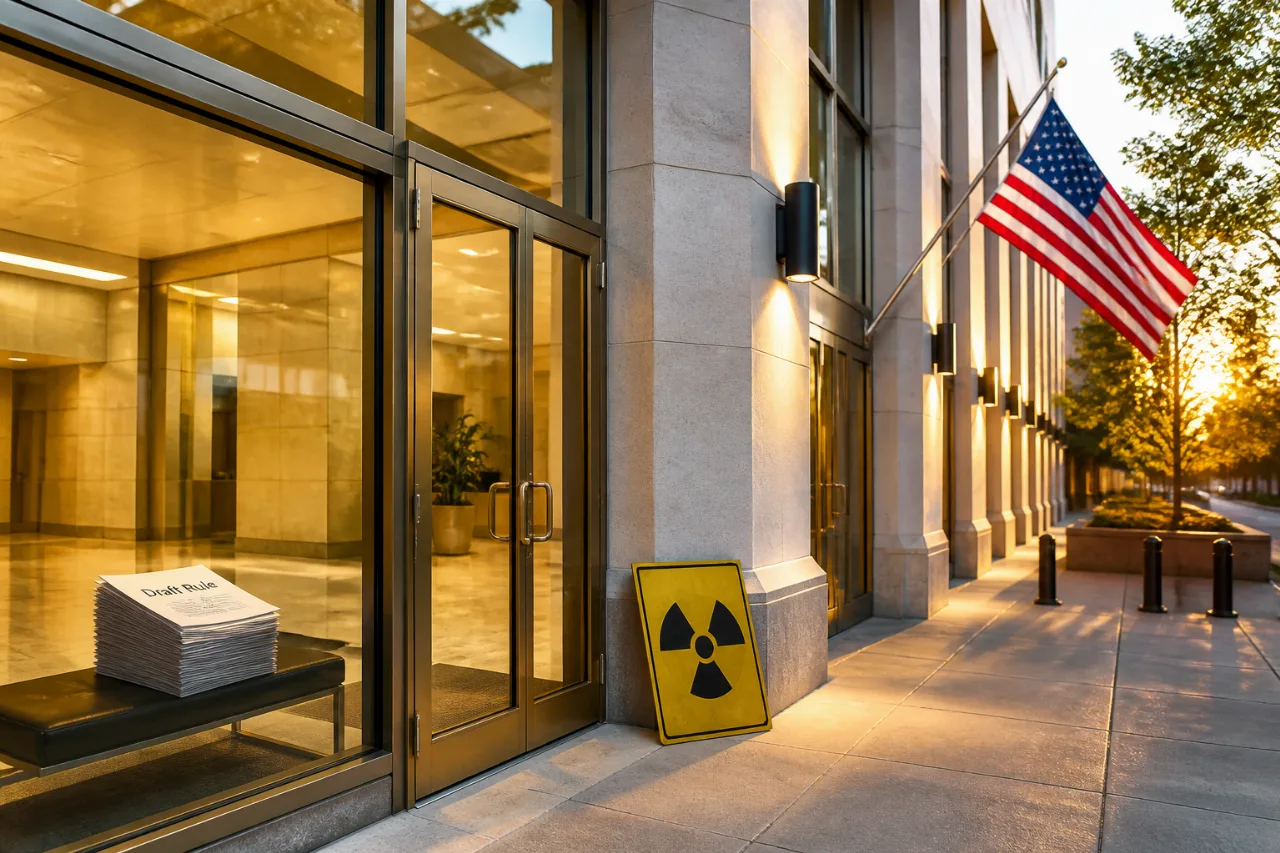
The Nuclear Regulatory Commission released a draft of a proposed rule that would retain the linear no-threshold (LNT) framework for radiation risk but would eliminate the regulatory obligation for licensees to maintain exposures "as low as reasonably achievable" (ALARA).
What the NRC proposes
The NRC’s draft text signals continuity on the scientific model used to estimate radiation harm: the agency would continue to treat increased cancer risk as directly proportional to dose, with no exposure threshold considered completely safe. At the same time, the rule would strike ALARA language from NRC regulations that currently directs licensees to minimize exposures to the greatest extent reasonably possible.
Why the change now
The move follows a White House executive order issued in May 2025 that criticized the existing framework and urged the NRC to reconsider reliance on both LNT and ALARA. That order described the models as lacking “sound scientific basis” and encouraged consideration of determinate limits. The NRC’s drafting of a rule comes amid broader federal shifts: the Department of Energy has already altered its own radiation rules over the past year to remove similar language, though DOE did so without a public rulemaking process.
"lack sound scientific basis and produce irrational results, such as requiring that nuclear plants protect against radiation below naturally occurring levels."
Scope and consequences
The NRC regulates commercial nuclear reactors and most civilian uses of radioactive materials, including those in hospitals. DOE regulations apply to reactors and radioactive activities under its purview and to certain contractor-operated facilities, such as those in the DOE Reactor Pilot Program. Changing NRC regulatory language could therefore affect a broad set of licensees and practices across industry and medicine.
- Agency would keep the LNT model for risk estimation.
- Regulatory duty to maintain ALARA would be removed from NRC rules.
- Change follows a May 2025 executive order pressing reform and aligns with prior DOE rule changes.
Technical and policy trade-offs
Under LNT, even very small doses are treated as contributing to cancer risk in direct proportion to dose. The ALARA principle logically follows from that assumption by directing licensees to reduce exposures as much as is reasonably possible. Removing ALARA does not alter the agency’s stated reliance on LNT in the draft, but it does change the regulatory emphasis from an explicit minimization mandate to whatever alternative compliance approach the final rule will specify.
| Element | Current practice | Proposed change |
|---|---|---|
| Risk model | Linear no-threshold (LNT) | Remain with LNT |
| ALARA requirement | Explicit regulatory duty | Remove from NRC regulations |
The NRC’s draft is a preliminary step in a public rulemaking process that could reshape how federal regulators balance scientific models, risk management practices and operational requirements across the civilian nuclear enterprise. Stakeholders from industry, public health and medicine are likely to scrutinize both the scientific rationale and the practical consequences as the rulemaking moves forward.
— Nathan Cole, Science Reporter, News Block