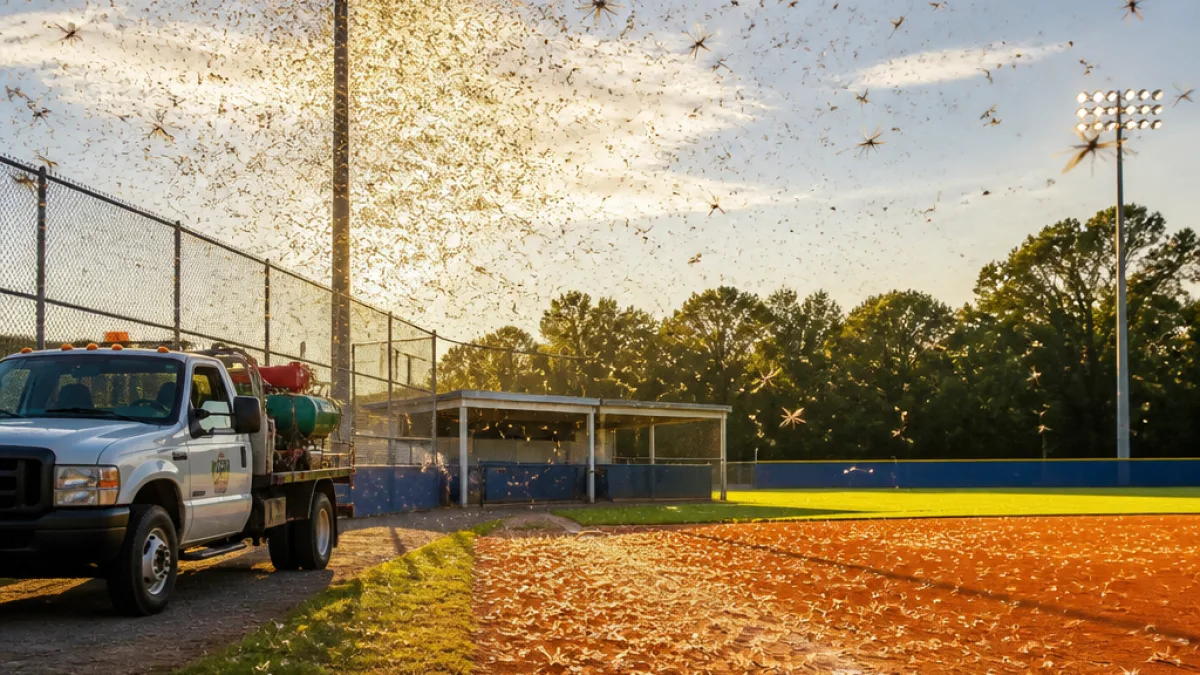
Mississippi communities are confronting an increasingly visible and troublesome invader: Formosan subterranean termites. A large swarm in early May that interrupted a high school softball championship has become a touchpoint for experts who say the species is moving inland from the coast and now appears in parts of dozens of counties.
What happened on the field
The incident in early May involved masses of winged reproductive termites — known as swarmers — overrunning a softball diamond, forcing officials to delay play. Local pest professionals and university extension specialists called it one of the most intense swarming events residents had seen in years, drawing attention to a broader pattern of spread across the state.
"It was one of the largest swarming events that many Mississippians have seen in quite a while, and maybe ever,"
— Santos Portugal, urban entomologist, Mississippi State University Extension Service
Why the swarm matters
Formosan termites are not native to Mississippi. Unlike native subterranean termites that play a useful role breaking down dead wood, Formosan colonies can be larger, more aggressive and more destructive. State and local experts say the pests can cause nuisance problems — gathering around lights, filling neighborhoods and disrupting outdoor events — while also posing a greater threat to structures and wooden materials.
- Seasonality: Swarming typically occurs from late April through June, often after rains and around sunset.
- Attraction to light: The insects are strongly drawn to artificial lighting and can accumulate around porches and playing fields.
- Range: Established populations reported in parts of 26 counties in south and central Mississippi, with isolated detections farther north.
Local observations and concerns
Kolby Krohn, a certified entomologist and chief operating officer of a Biloxi-based pest control firm, described the visual impact and nuisance behavior of the swarms. Residents reported insects getting into clothing and hair during the outbreak, and pest managers noted unusually high numbers compared with typical seasonal activity.
"It's almost like it's snowing outside because there's so many termites swarming all at one time, millions and millions,"
Such dense swarms raise questions about whether control efforts and public awareness are keeping pace with the pest’s spread.
Statewide picture
Mississippi State University Extension personnel have tracked Formosan detections for years. According to their reports, the species is firmly established in parts of two dozen counties along the south and into central regions of the state, and occasional, isolated collections have turned up in several northern counties.
| Metric | Detail |
|---|---|
| Counties with established populations | 26 (south and central Mississippi) |
| Season of typical swarms | Late April–June (after rain) |
| Noted nuisance behaviors | Attraction to lights, infiltration of clothing and hair, event disruption |
What residents should know
Homeowners and property managers should be aware that Formosan termites can cause extensive damage if left unchecked. Because the insects often travel from established colonies and are drawn to lights, simple steps can help reduce encounters: minimize outdoor lighting during peak swarm hours, seal obvious gaps in doors and windows, and contact a licensed pest professional if large numbers of swarmers are found near structures. Local extension offices are a resource for reporting finds and getting guidance specific to each county.
The May softball-game interruption served as a stark reminder: when millions of swarmers take wing, the problem is not just an agricultural or ecological curiosity — it is a local nuisance with potential economic consequences for homeowners and communities across Mississippi.
Reporting from Biloxi and statewide sources informed this article.