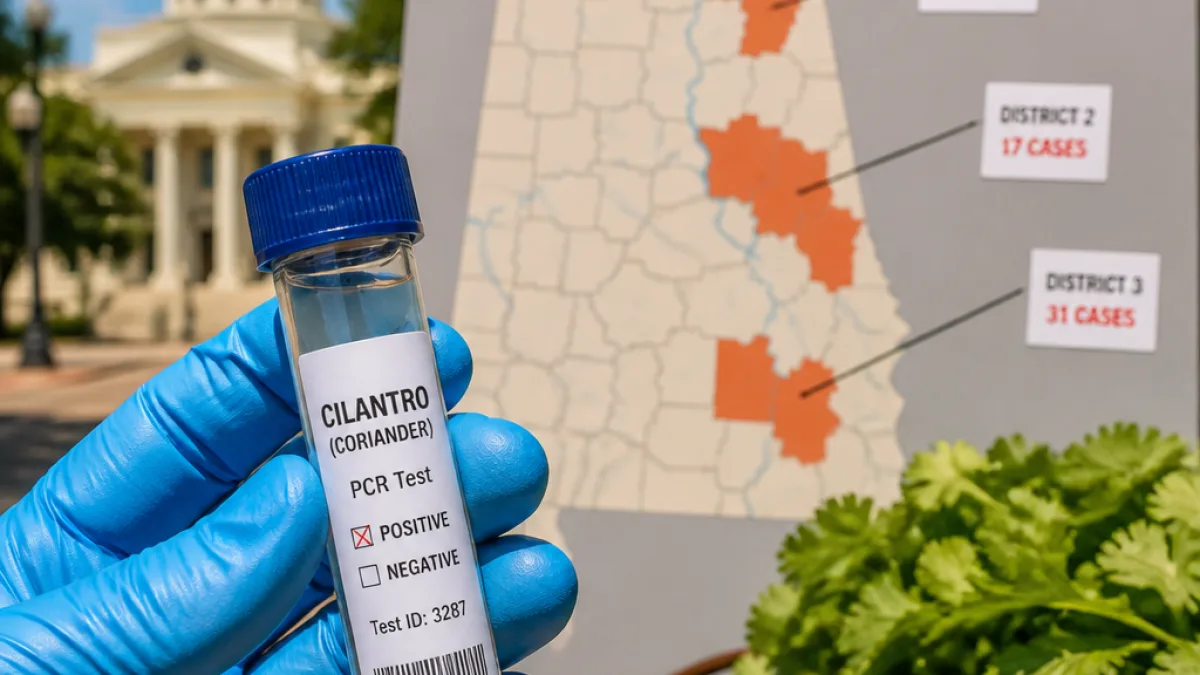
MONTGOMERY — The Alabama Department of Public Health on Wednesday confirmed 11 cases of cyclosporiasis in the state reported since May 1, officials said. The parasitic illness has been identified across three ADPH health districts and has prompted reminders on food safety and testing.
Where cases have appeared
ADPH officials said most cases are concentrated in the Northern District, which has reported nine of the infections. The remaining two cases are split between the Northeaster and Southwestern districts, with one case in each.
| District | Reported cases |
|---|---|
| Northern | 9 |
| Northeaster | 1 |
| Southwestern | 1 |
Known links and exposures
Of the 11 cases, ADPH said two are related to international travel. One case is associated with a foodborne outbreak tied to a local Mexican-style restaurant chain, according to Ryan Easterling, director of the Health Media and Communications Division at ADPH. The remaining cases have not been linked to those exposures based on the latest information.
“What has probably concerned a lot of people right now is that we haven’t identified that one food that we should be avoiding or that one brand, and so what we’re kind of falling back on is what we know has been typically associated with other outbreaks,”
The comment came from Dr. Rachael Lee, chief healthcare epidemiologist at the University of Alabama at Birmingham. ADPH epidemiologist DeJuana Grant reminded residents of how the parasite spreads: people can get infected by consuming food or water that is contaminated with the parasite.
Symptoms, risk reduction and testing
Symptoms of cyclosporiasis commonly include watery diarrhea, bloating and stomach cramps. ADPH said no hospitalizations or deaths have been reported in Alabama so far.
Health officials offered practical steps to reduce risk, including choosing locally grown produce or growing produce at home and using frozen produce as an alternative. ADPH officials noted these choices can lower the likelihood of exposure.
- If you have prolonged watery diarrhea, contact your healthcare provider for testing.
- Wash produce thoroughly, and follow guidance on safe food handling.
- Consider freezing produce when fresh local options are not available.
On the national level, the U.S. Centers for Disease Control and Prevention reported it had received more than 1,600 reports of cyclosporiasis since May 1, underscoring that outbreaks have been occurring in multiple states this season.
Local impact and what to watch for
For families, restaurants and farmers markets across Alabama, the immediate impact is heightened vigilance. ADPH is conducting investigations into the cases to try to identify common sources and any further links. Until a specific food product or brand is identified, officials emphasize general safe-food practices and prompt medical testing for symptomatic people.
Anyone who suspects they may have cyclosporiasis should reach out to their healthcare provider for testing and guidance. ADPH will continue to update the public as investigations progress.
Reporting from Montgomery.