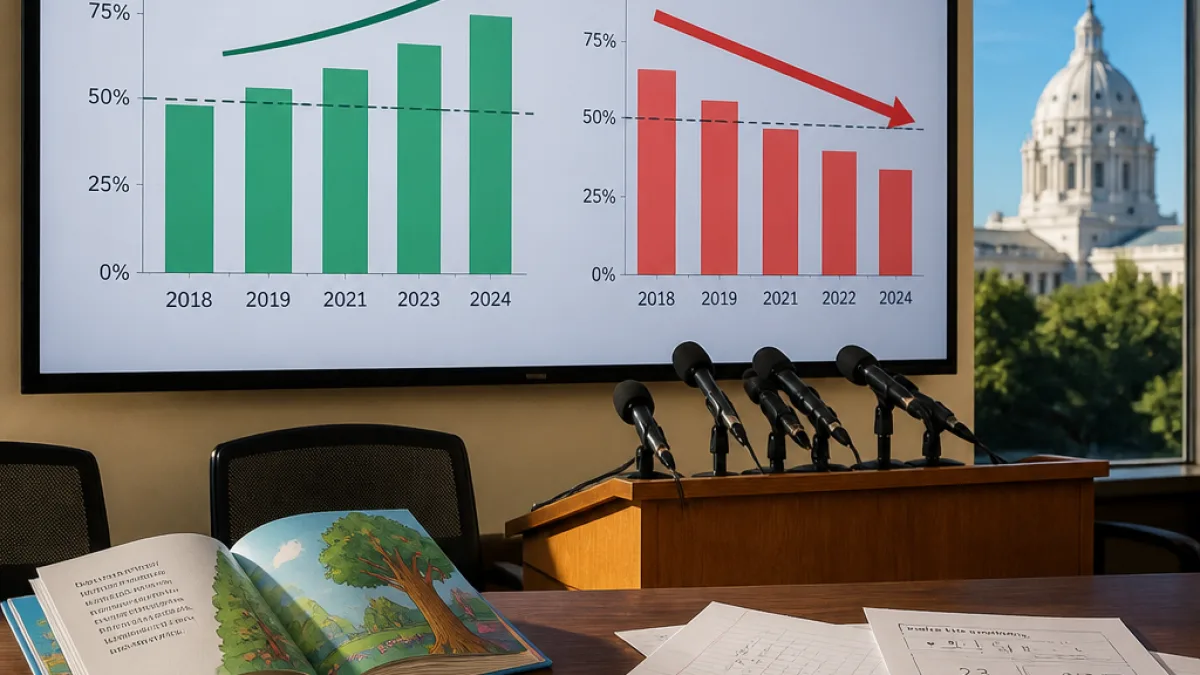
MONTGOMERY — Preliminary results presented to the Alabama State Board of Education Tuesday show students statewide made measurable gains in reading and on the ACT during the 2025-26 school year, even as math proficiency lagged behind.
Reading improves at several grade levels
Elementary and middle school students accounted for many of the strongest advances in English language arts. Among notable year-over-year improvements:
- Grade 2: reading proficiency rose from 60.0% to 63.6%
- Grade 5: increased from 68.1% to 70.3%
- Grade 8: climbed from 54.9% to 59.1%
Not every grade moved upward: third-grade proficiency remained essentially unchanged at 65.6%, while fourth- and seventh-grade reading percentages dipped slightly compared with the prior year.
Math gains modest; proficiency remains low
While some grades showed small improvements in mathematics, the overall picture remains concerning: no tested grade reached a 50% proficiency threshold. Examples of modest increases include:
- Grade 2: up from 46.1% to 49.2%
- Grade 6: rose from 34.3% to 35.5%
- Grade 8: increased from 24.8% to 26.6%
Even after gains, fewer than half of second graders met math proficiency, and eighth-grade proficiency remained below 30%.
| Subject | Notable change |
|---|---|
| English language arts | Multiple grades improved, including Grades 2, 5 and 8 |
| Mathematics | No grade reached 50% proficiency; small improvements in some grades |
| ACT (with Writing) | Proficiency rose in ELA, math and science; average composite up to 17.65 |
High school ACT shows movement
High school students taking the ACT with Writing posted gains across the three reported subjects: English Language Arts proficiency grew from 30.3% to 33.8%, math from 23.9% to 27.5%, and science from 31.9% to 36.0%. The statewide average ACT composite score rose to 17.65, up from 17.31 the previous year and marking the highest composite in three years.
Science results show sharp increases, warranting caution
Science proficiency numbers improved markedly across multiple grades. Fourth-grade science moved from 42.5% to 50.5%, sixth grade increased from 34.6% to 41.0%, and eighth grade climbed from 41.4% to 54.3%. Officials advised care in interpreting those jumps as the department continues to review testing conditions and year-to-year comparability.
For parents and local educators, the results point to steady progress in literacy and improved college-readiness signals from the ACT, but they also highlight persistent challenges in math that districts and state leaders will likely prioritize in coming school improvement efforts.
These figures are preliminary and were presented to the State Board of Education; state officials and local school systems will continue refining and reviewing the data as they plan interventions for the next school year.