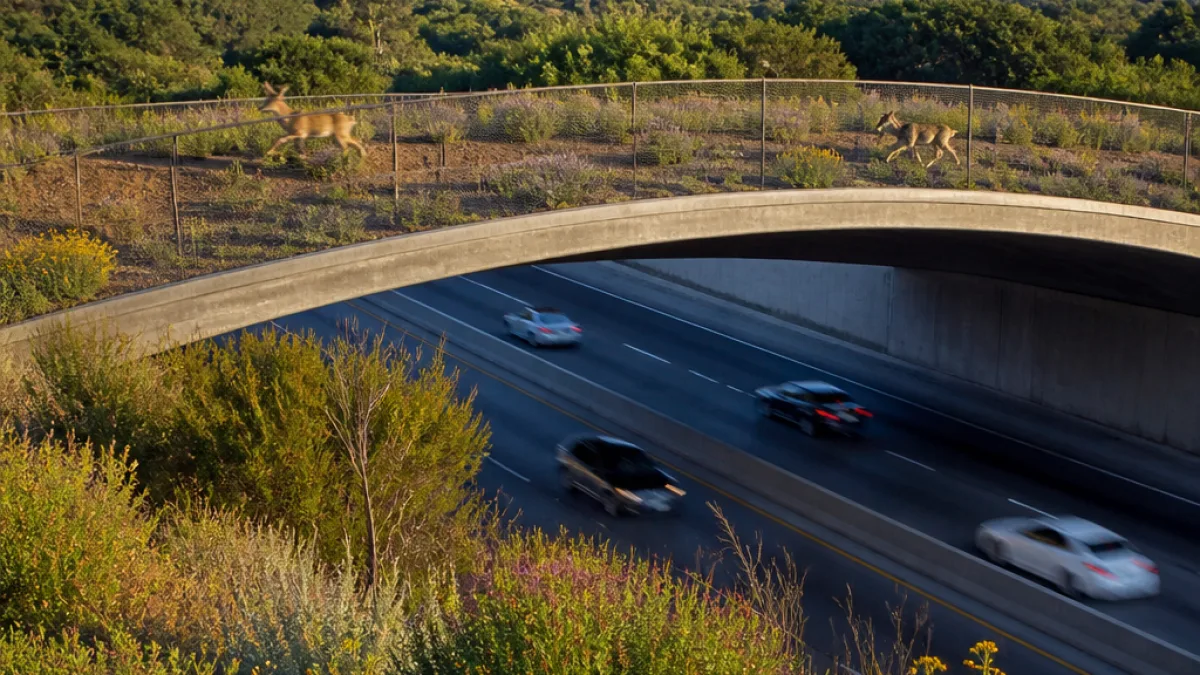
Agoura Hills — A sweeping wildlife bridge across the 101 Freeway is coming to life, and local residents will soon see nature reclaim a corridor severed for decades.
The Wallis Annenberg Wildlife Crossing, a $114 million project at Liberty Canyon, is being planted with native species from the Santa Monica Mountains. Officials say the vegetation and engineered habitat are intended to give coyotes, deer, bobcats and endangered mountain lions a safer route to travel across the busy highway.
What this means for residents
- Reduced wildlife-vehicle collisions along stretches of the 101 where animals historically attempted to cross.
- Restored habitat connectivity for large mammals and smaller species in the Santa Monica Mountains.
- New public awareness and educational opportunities as the site becomes a visible conservation landmark.
Beth Pratt, regional executive director for California at the National Wildlife Federation, led a recent walk-through on the unfinished span and pointed out California poppy, white sage and other native plants taking root. Pratt also noted the return of pollinators and birds to the structure.
“I’ve recorded about eight species of birds, nine species of butterfly, and one American kestrel up here,” Pratt said. “It’s really fun to see the wildlife responding.”
Construction officials have scheduled the bridge to open on Dec. 2. When complete, project managers say it will be the largest wildlife crossing of its kind in North America, surpassing the Greenland Wildlife Overpass in Douglas County, Colorado, that opened in December 2025.
Design and early signs of success
The crossing is being planted with vegetation chosen to match the surrounding mountain landscape so animals approaching the span find familiar habitat. Pratt lifted a volcanic stone during the tour to show how the materials and microhabitats are being integrated to mimic natural conditions.
Early observations by conservationists suggest the structure is already attracting a variety of wildlife: native bees hovering over poppies, multiple butterfly species and a range of birds, including a kestrel. Those early arrivals are being tracked by environmental groups monitoring how quickly wildlife resumes use of the corridor.
| Feature | Detail |
|---|---|
| Project cost | $114 million |
| Location | Liberty Canyon, Agoura Hills |
| Scheduled opening | Dec. 2 |
| Notable beneficiaries | Coyotes, deer, bobcats, mountain lions, birds, pollinators |
Wildlife crossings have gained attention nationwide as a tool to reduce fragmentation caused by highways and development. Supporters view the Wallis Annenberg span as a model for how urban and suburban regions can combine engineering, landscape design and ecology to reconnect habitat and reduce risks to both animals and drivers.
As plantings mature and monitoring continues, residents can expect to see more wildlife using the span in the months after it opens. Officials and conservation groups plan to continue documentation to assess how effectively the crossing restores long-distance movement for the region’s larger mammals.
Local commuters should watch for outreach from transportation and conservation agencies about any related traffic impacts around opening events or long-term monitoring activities.