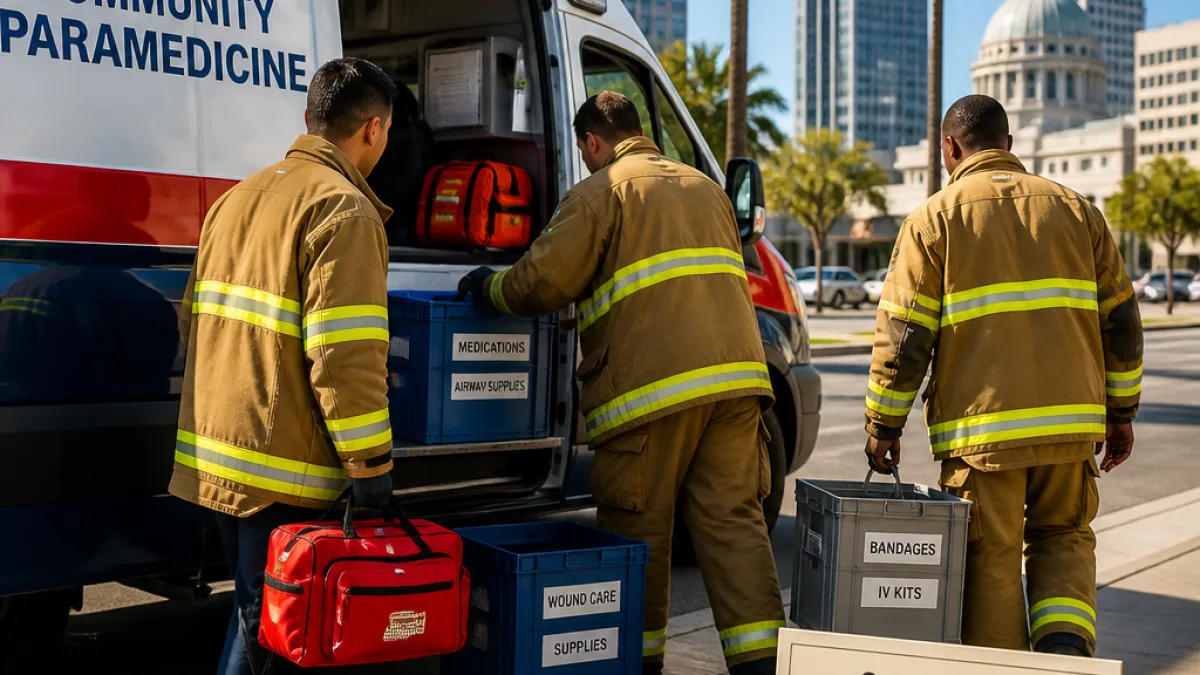
San Jose is preparing to pilot a community paramedicine program aimed at reducing repeat emergency responses by connecting high-need patients to housing, behavioral health and social services instead of repeatedly transporting them to hospital emergency rooms.
What changes for residents
The City Council approved the pilot as part of the recent annual budget process. The program will place firefighter paramedics in roles focused on patients with complex needs—those with chronic illness, mental health challenges or substance use disorders—who frequently generate emergency calls.
Officials said the team will offer timely, lower-cost interventions such as arranging transportation to mental health providers, helping locate housing supports, coordinating elder care or linking residents with reduced-cost meals.
“There are just a lot of basic things out there that people need help with,” Fire Chief Robert Sapien told San José Spotlight. “We hope what we will achieve is help individuals in our community get out of the cycle of really high-cost services that don’t give them what they ultimately need.”
Funding and staffing
The pilot is funded with a $764,000 allocation drawn from a settlement payout that the city received in a class-action lawsuit involving companies in the opioid industry. The allocation will cover three positions and the purchase of equipment needed to support the unit.
| Item | Planned support |
|---|---|
| Funding source | Opioid settlement payout |
| Amount | $764,000 |
| Staffing | 3 positions |
| Equipment | Purchase of new equipment (unspecified) |
Timeline and approvals
San Jose officials are working with Santa Clara County to develop a program proposal. The city says the pilot must be approved by state authorities before it can begin operations. If state approval is obtained, the unit could be on the street as soon as this fall.
Why the city is pursuing the model
Backers of the pilot say traditional paramedic responses often address immediate medical symptoms but not the underlying social or behavioral drivers that lead to repeat emergency calls. City and fire officials contend that a focused paramedicine team can reduce cycling between the emergency room, the street or the criminal justice system while offering more appropriate, cost-effective care.
- Program funded with $764,000 from opioid settlement.
- Will staff three firefighter paramedics and buy new equipment.
- Proposal being developed with Santa Clara County; state approval required.
The proposal shifts some emergency response resources toward case management and social-service navigation, reflecting a broader trend in California cities to tailor first-responder roles for nontraditional needs. City residents can expect more targeted follow-up for frequent callers if the pilot moves forward.