
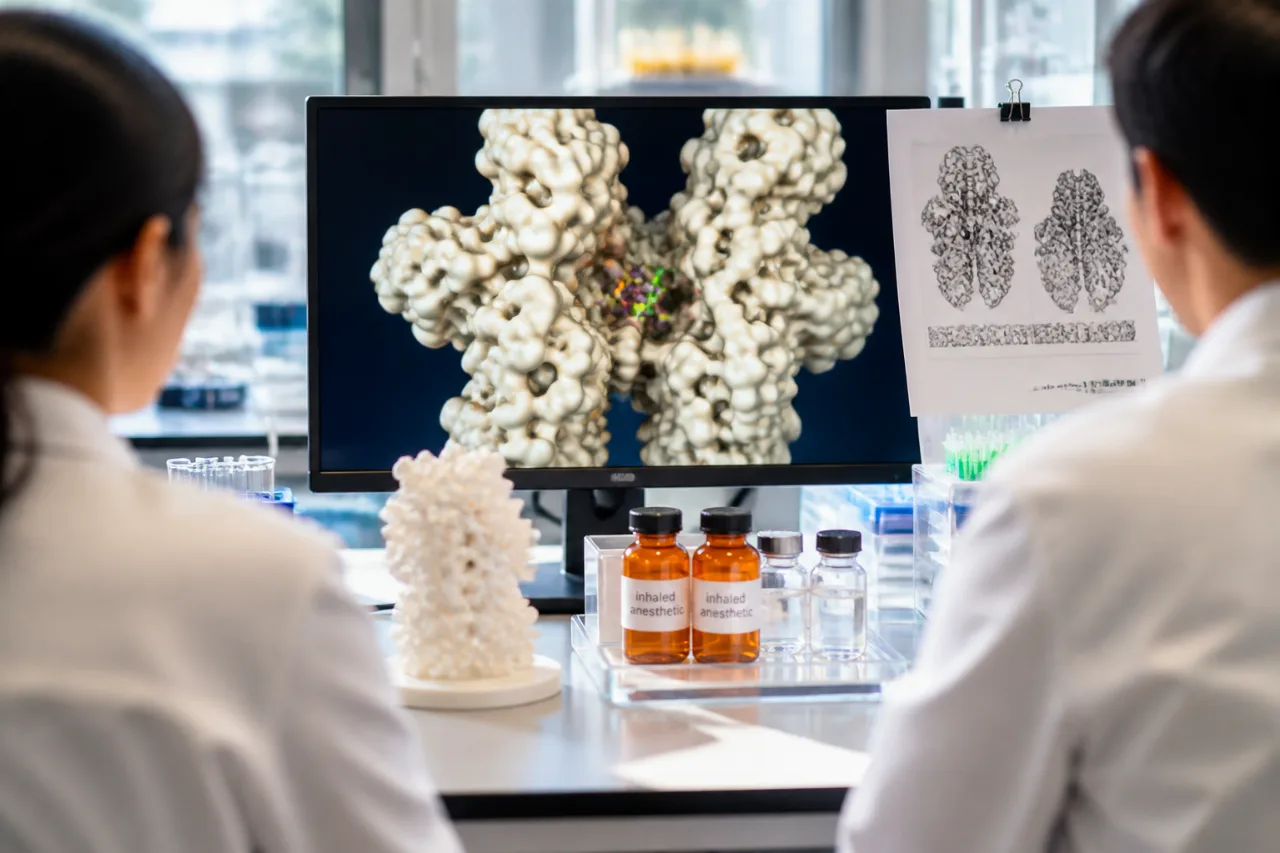
Researchers at Weill Cornell Medicine and Birkbeck, University of London have located the binding site for a commonly used inhaled anesthetic on voltage-gated sodium channels, offering an atomic-level explanation for how these drugs blunt communication between neurons and produce unconsciousness.
What the team found
Using structural techniques applied to a bacterial sodium channel that serves as a manageable stand‑in for the far larger mammalian proteins, the investigators identified a pocket where the anesthetic sevoflurane attaches and holds the channel in an inactive configuration. That stabilization reduces sodium flow across neuronal membranes, lowering the ability of brain cells to generate and propagate electrical signals.
“Sodium channels are critical for communication between neurons in the brain, and anesthesia breaks down that communication,” said Dr. Hugh Hemmings, who co-led the research and is senior associate dean for research and chair of anesthesiology at Weill Cornell.
Why this matters
Anesthetics have been used safely in medicine for more than a century, yet precisely how volatile inhaled agents induce unconsciousness has remained a major unanswered question. By pinpointing a drug-binding site and showing its functional effect on channel gating, the study provides a mechanistic link between molecular interaction and the widespread reduction in neural signaling seen under anesthesia.
- Mechanism clarified: Binding stabilizes sodium channels in an inactive state, reducing neuronal excitability.
- Method: Structural analysis of a simpler bacterial sodium channel enabled atomic-resolution insight not yet possible with mammalian channels.
- Implication: Knowledge of the binding pocket could inform the development of anesthetics with improved selectivity and fewer side effects.
Context and next steps
The research traces back to hypotheses from decades ago suggesting volatile anesthetics interact with ion channels, particularly voltage-gated sodium channels that underpin electrical signaling throughout the nervous system. Mammalian sodium channels are large and structurally complex, complicating direct high‑resolution study; the team therefore turned to a structurally simpler channel from the marine bacterium Magnetococcus marinus as a tractable model.
Co-first author Dr. Karl Herold described the potential practical payoff: insights from this atomic view could be used to design anesthetic agents that target specific channel states or subtypes, potentially reducing collateral effects on other tissues.
| Institution | Contribution |
|---|---|
| Weill Cornell Medicine | Led research, structural and functional analysis |
| Birkbeck, University of London | Collaborative structural biology work |
The findings, published in Nature Communications, do not claim that sodium channels are the sole mediators of anesthetic-induced unconsciousness but they establish a concrete molecular interaction that plausibly contributes to the breakdown of neuronal communication observed with inhaled agents. That molecular foothold gives researchers a clearer target for designing drugs that achieve the necessary depth of anesthesia while minimizing unwanted systemic effects.
Clinical and research audiences should view this as a step toward translating structural insight into better therapeutics: the path from atomic structure to approved drug remains long, but this study removes a key unknown that has persisted for generations of clinicians and scientists.