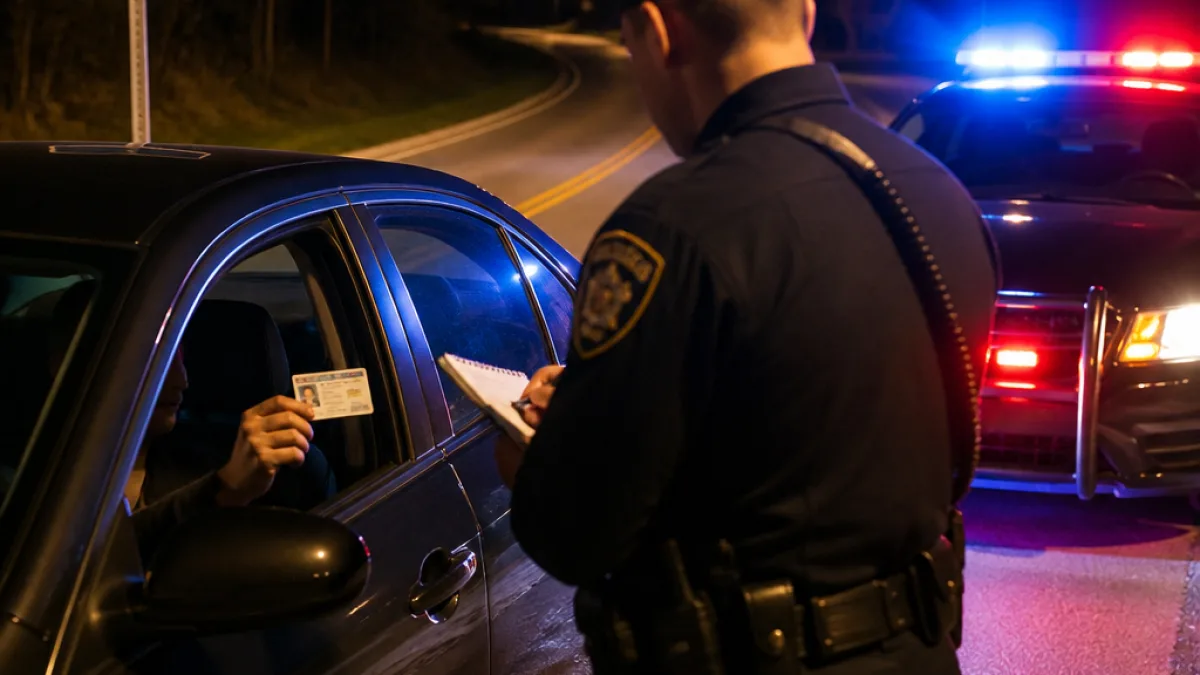
Ohio drivers and passengers will be required to give basic identification to police during traffic stops beginning in early October under a new law enacted this year.
House Bill 492, signed by Gov. Mike DeWine after receiving primarily Republican support in the Legislature, creates a new criminal offense for a person in a stopped vehicle who does not disclose their name, date of birth and address when an officer “reasonably suspects” the person may have violated Ohio motor-vehicle laws. The failure to provide that information is a fourth-degree misdemeanor, according to the law.
What the law changes
The measure also raises the penalty for obstructing an officer during an arrest tied to a motor-vehicle violation: such interference is now classified as a second-degree misdemeanor. Supporters said the changes were designed to close a gap between situations in which police can require identification for suspected criminal conduct and routine traffic enforcement, where many violations are not classified as crimes.
"This has serious implications not only for the enforcement of our traffic laws but of our criminal law as well," said Lou Tobin of the Ohio Prosecuting Attorneys Association, testifying that the bill would help police identify people with outstanding warrants who might otherwise go undetected.
Rep. Cindy Abrams, a Cincinnati Republican and former police officer who carried the bill through committee, described the law as an "extra tool in the toolbox" for law enforcement during committee discussion.
Support and enforcement
The bill drew backing from a number of law enforcement advocacy organizations and unions during the legislative process. Proponents argued the change would help officers complete identity checks during traffic stops and strengthen public-safety responses.
Law enforcement agencies will need to develop local policies and training for officers to apply the new standard — requiring that an officer must have a "reasonable suspicion" that a motor-law violation occurred before requesting identifying information from vehicle occupants. The law does not alter existing protections or procedures for when a stop escalates into an arrest for other crimes.
- Effective: Early October (year in the law)
- Refusal to identify: Fourth-degree misdemeanor
- Interfering with arrest: Second-degree misdemeanor
| Offense | Penalty |
|---|---|
| Refusal to identify during traffic stop | Fourth-degree misdemeanor |
| Interfering with officer during arrest for motor violation | Second-degree misdemeanor |
For Ohio counties and municipalities, the law may increase short-term arrest processing tied to traffic enforcement and could prompt policy updates for police departments and prosecutor offices. Courts will also see cases under the new misdemeanor provisions.
Motorists should be prepared, when stopped and when an officer has a reasonable suspicion of a motor-law violation, to provide the named identifying details. Drivers who have questions about how the law will be applied locally can contact their county sheriff's office or municipal police department for guidance on local procedures.
This change is part of a broader legislative package in H.B. 492 that addressed multiple aspects of motor-vehicle enforcement and interactions between police and the public.