
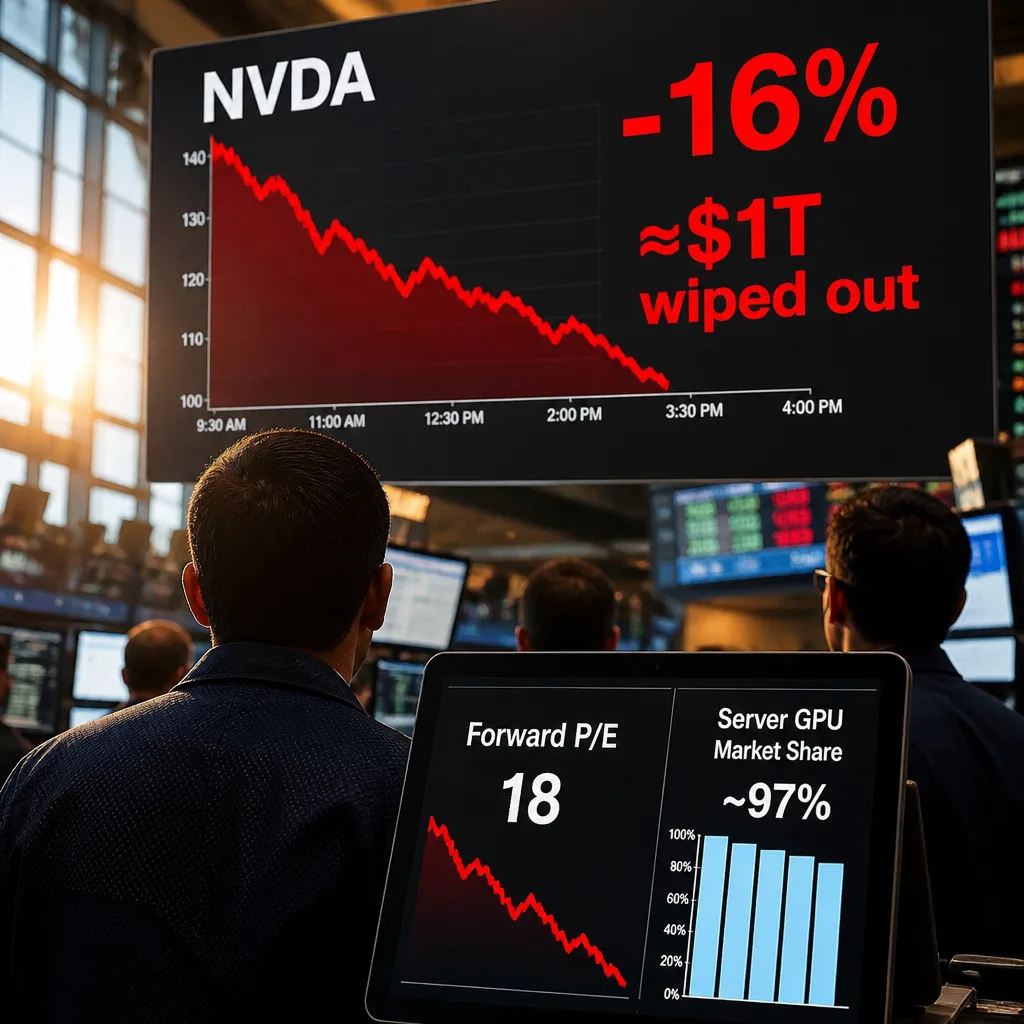
Shares of Nvidia have fallen sharply since mid-May, wiping away roughly $1 trillion in market capitalization after a slide of about 16% from the company's peak on May 14, 2026. The decline brings the chipmaker's valuation to its lowest point since early 2019, before the surge tied to generative artificial intelligence investment.
Valuation vs. fundamentals
Despite the market setback, forward-looking financial metrics show Nvidia trading at a forward price-to-earnings ratio near 18, according to Bloomberg data cited in reporting. That multiple places the company below the broader market, where the S&P 500 trades above 20 and the Nasdaq 100 is near 23. The shift in multiples suggests investors have rotated capital away from Nvidia toward other semiconductor segments.
Market share and analyst outlook
Evidence of underlying business strength remains: Nvidia's share of the server GPU market climbed to approximately 97% at the end of 2025, up from about 95% the year before. Wall Street analysts, as reported, continued to raise profit forecasts even as the stock price fell, indicating that the move is driven more by investor positioning than company performance.
- Price move: ~16% decline from May 14 peak
- Market value impact: ~ $1 trillion erased
- Forward P/E: ~18, below S&P 500 and Nasdaq 100
- Server GPU share: ~97% at end-2025
Where investor money went
Market flows favored other parts of the chip sector, notably memory and storage names. The Philadelphia Semiconductor Index has performed strongly this year, rising about 74%. Memory-maker Micron was a standout, with its stock up roughly 229% in 2026 following an earlier surge of about 239% in 2025. That rotation toward memory and storage equities helped drive relative weakness in Nvidia shares despite robust demand for its data-center products.
| Metric | Reported value |
|---|---|
| Decline from peak | ~16% |
| Market value lost | ~$1 trillion |
| Forward P/E (Nvidia) | ~18 |
| Philadelphia Semiconductor Index YTD | ~74% gain |
| Micron 2026 performance | ~229% gain |
Impact for households and businesses
For households, the swing in Nvidia's market capitalization has immediate relevance for investors with exposure to large-cap technology names through retirement accounts, ETFs or individual holdings—particularly funds heavily weighted to megacap AI beneficiaries. Portfolio volatility of this scale can affect retirement savings trajectories and may prompt rebalancing decisions.
Businesses in the semiconductor supply chain and customers that depend on GPU capacity should watch two dynamics: demand fundamentals, which remain strong given Nvidia's dominant data-center position, and capital-market willingness to fund continued expansion. A sustained re-rating could make equity financing less attractive for chipmakers, while stronger interest in memory and storage companies may channel investment and merger-and-acquisition attention elsewhere in the sector.
In short, the move reflects a market rotation rather than clear evidence of deterioration in Nvidia's operations. Still, the speed and scale of the valuation change underscore how quickly investor sentiment can reshape the landscape for major technology firms and the portfolios and businesses tied to them.