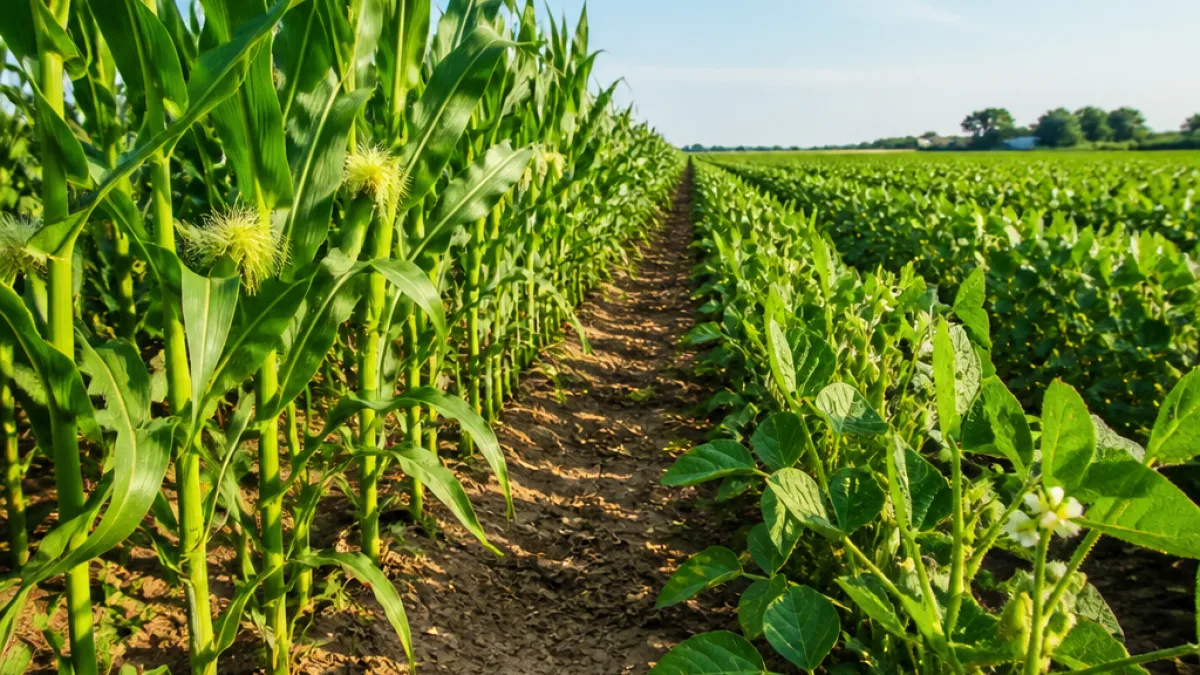
Iowa’s corn and soybean crops made a sizable jump in development during the July 6–12 reporting period, according to the latest U.S. Department of Agriculture crop progress and condition report. After several weeks running behind last year’s pace and the five-year average, much of the state saw accelerated crop stages following a week of warm, relatively dry weather.
Silking surges, dough still limited
USDA data show 38% of Iowa corn acres were silking in the July 6–12 window — that’s 9 percentage points ahead of the five-year average and 5 points ahead of 2025. By contrast, only 1% of corn acres had reached the dough stage, still behind last year and the five-year mean.
Corn condition held steady overall: 78% of corn acres were rated in good or excellent condition. Farmers who expected more moisture said a short dry spell following early July rains left many fields with adequate but not abundant soil moisture.
Soybeans continue to advance
Soybean progress also moved ahead during the same period. USDA reported 56% of soybean acres were blooming — 5 points ahead of last year and 6 points ahead of the five-year average — while 16% of acreage was setting pods. Overall soybean condition was reported at 74% good to excellent.
"I would take some more rain, but the previous two years, we’ve had excess rain and really suffered production wise because of it. So I’d rather be just on the dry side instead of just on the wet side,"
— Stu Swanson, chair of the Iowa Corn Growers Association and a Wright County farmer.
Short stretch of dryness, but soil moisture mostly adequate
State Climatologist Justin Glisan described the July 6–12 period as “unseasonably dry,” with a statewide weekly average precipitation of 0.66 inch. Soil-moisture measures in the report showed the majority of fields with adequate reserves: 73% of topsoil and 69% of subsoil were rated adequate for the period.
- Rapid shift in corn development: from 8% silking the previous week to 38%.
- Corn condition: 78% good to excellent.
- Soybean condition: 74% good to excellent; 56% blooming, 16% setting pods.
- Weekly precipitation averaged 0.66 inch statewide; most soil moisture rated adequate.
For many producers, the change in pace is a reminder of how quickly field conditions can move in midseason. A significant increase in silking can compress the window for management decisions such as irrigation scheduling, fungicide application and insect scouting.
| Crop measure | Percent | Context |
|---|---|---|
| Corn silking | 38% | 9 points ahead of five-year average |
| Corn dough | 1% | Behind 2025 and five-year average |
| Corn good/excellent | 78% | Stable condition |
| Soybean blooming | 56% | 6 points ahead of five-year average |
| Soybean setting pods | 16% | Slightly behind 2025 but ahead of average |
| Soybean good/excellent | 74% | Healthy overall |
| Weekly precipitation | 0.66 in | Described as unseasonably dry |
| Topsoil adequate | 73% | |
| Subsoil adequate | 69% |
Local farmers’ reactions reflected mixed relief: some appreciate drier conditions after years of excessive rainfall, while others would welcome timely showers to sustain yield potential during pollination and pod fill. As the calendar moves into the heart of summer, those moisture and timing questions will shape decisions on inputs and harvest expectations across the state.
Producers and agribusinesses will be watching weekly USDA updates closely over the coming months for further signs of pace and condition changes that will affect regional yields and markets.