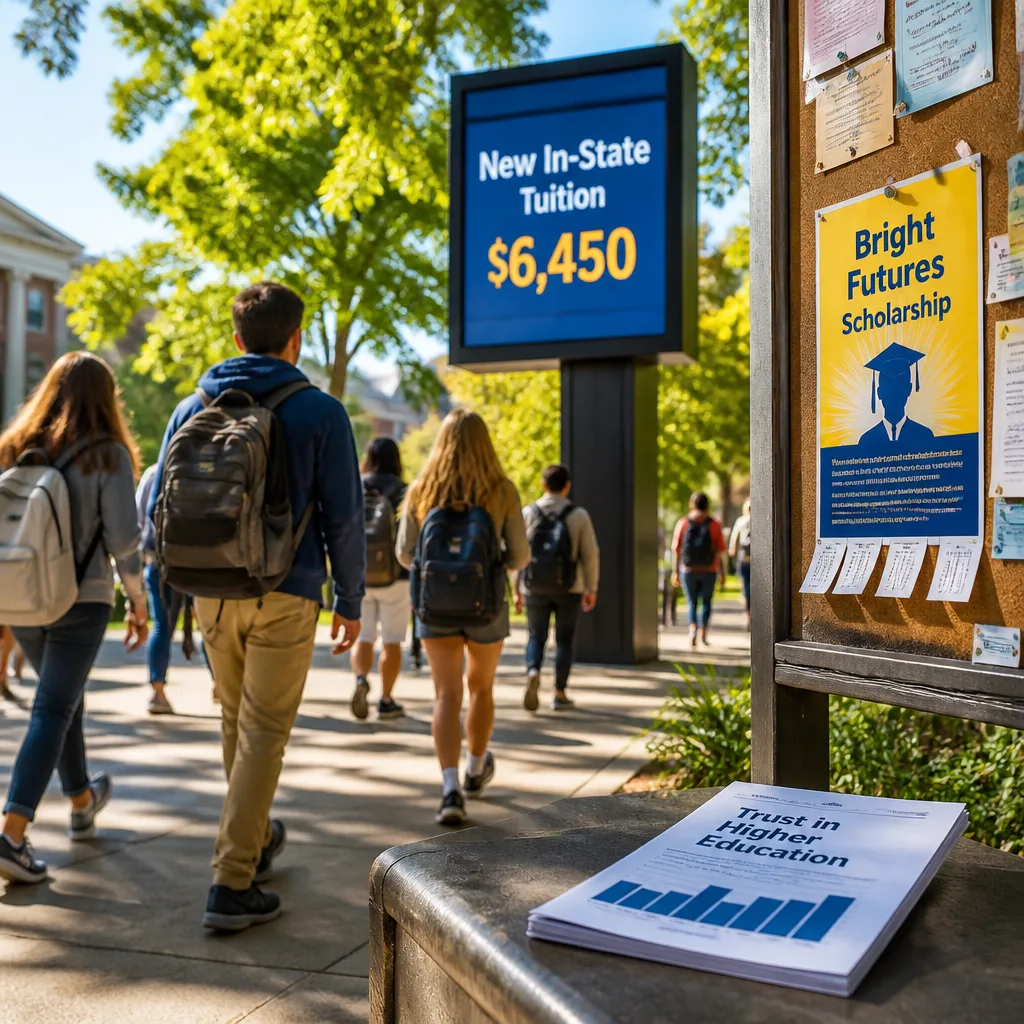
The Yale Committee on Trust in Higher Education issued a report earlier this year identifying major sources of public distrust in colleges and universities and setting out 20 recommendations for reform. The committee highlighted three chief public concerns — the rising cost of college, opaque admissions practices and disputes over campus speech and curriculum — and identified internal challenges such as grade inflation, classroom distraction and administrative growth.
Public confidence has fallen sharply
Public sentiment has shifted markedly: where a decade ago a majority said they had a high level of confidence in higher education, by 2024 that proportion had declined substantially. The Yale report points to the drop as a signal that institutions must tackle concrete, visible problems to rebuild credibility.
"essential for rebuilding public trust."
The report explicitly frames reducing college costs as central to that effort. One state that illustrates a clear strategy on affordability is Florida.
How Florida compares on price and aid
Florida’s approach combines relatively low in-state tuition at its flagship public universities with an expansive scholarship program that helps many residents attend college with limited out-of-pocket cost. At Florida State University, in-state tuition is reported at $6,500, a figure notably below comparable flagship universities in neighboring and peer states.
| Institution/State | Reported in-state tuition |
|---|---|
| Florida State University (Florida) | $6,500 |
| Flagship public (Georgia) | over $11,000 |
| Flagship public (Tennessee) | nearly $14,000 |
| Flagship public (South Carolina) | close to $13,000 |
Florida also operates the Bright Futures scholarship program, which the state uses to reduce tuition burdens for qualifying students, and state lawmakers have prioritized funding higher education as a public good. Even nonresident tuition at FSU is reported to be among the lowest for top public universities, according to the material examined.
What this means for families and policymakers
The Yale report and Florida’s policies intersect on clear, practical points: lowering sticker price and increasing aid can make college more accessible and demonstrably address one of the public’s primary complaints. For parents and prospective students, state-level funding choices and scholarship eligibility rules materially affect affordability and planning for college costs. For policymakers and university leaders, Florida’s model offers one concrete example of aligning state investment and institutional pricing to improve access.
- Affordability: Lower in-state tuition and scholarship programs reduce immediate cost barriers for many families.
- Transparency: Clear state-driven pricing and scholarship rules can counter perceptions of admissions opacity and hidden costs.
- Accountability: Public universities working with legislatures can implement reforms that are visible to taxpayers and students.
The Yale report also raised other concerns beyond price — such as admissions transparency and campus discourse — that require different remedies. While Florida’s actions illustrate progress on affordability, the broader set of recommendations in the Yale report addresses institutional practices and academic norms that states and campuses would need to confront separately.
Readers planning for college should watch state tuition schedules, scholarship application windows and eligibility requirements, which determine how much of these policy shifts will affect family budgets. For national education leaders, Florida’s example reinforces that some recommendations from the Yale committee are already in practice in certain states, offering a potential starting point for broader adoption where political and fiscal conditions allow.