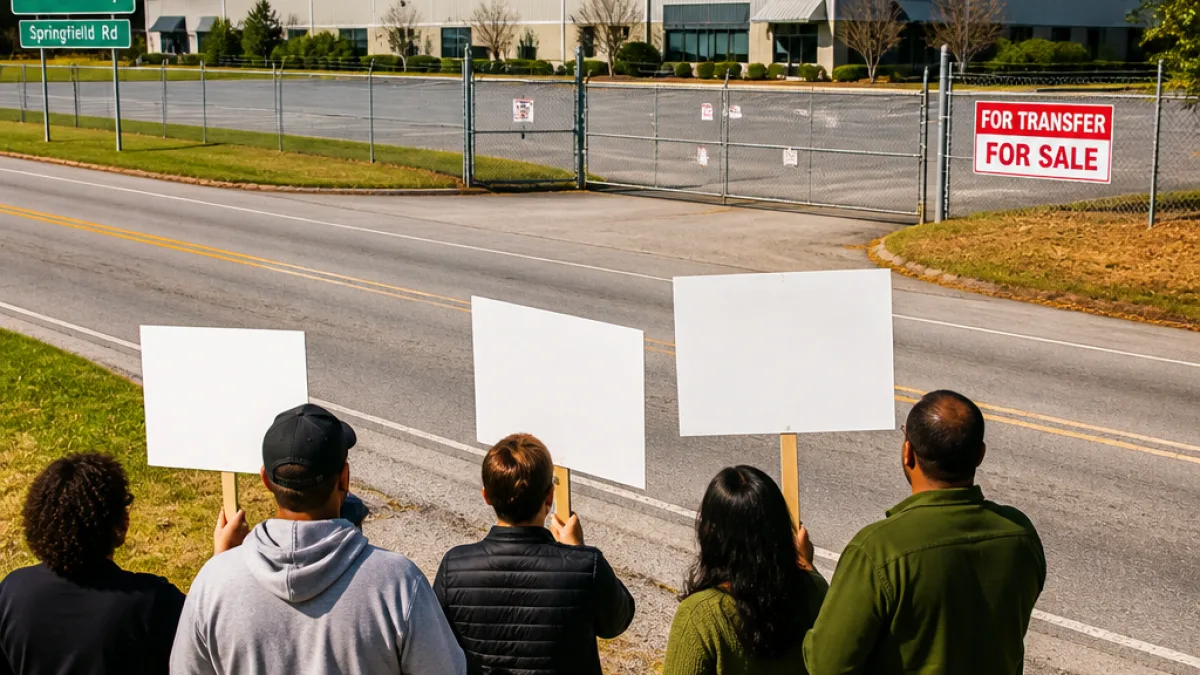
ATLANTA — U.S. Homeland Security Secretary Markwayne Mullin told reporters the federal government’s plan to convert a large warehouse in Walton County into an Immigration and Customs Enforcement detention site for about 500 people “wasn’t a good fit” for the surrounding community.
Local concerns shaped decision
The facility, located near the small city of Social Circle, had drawn public attention and opposition from residents and local officials. Mullin said the department would not push forward with a plan that didn’t have community buy-in, and described the decision as driven in part by logistical considerations.
“The truth is that it wasn’t a good fit for what we’re needing to do, logistically speaking,”
Mullin also said that if the department had chosen to keep the operation in Social Circle, officials would have spent substantial time working with the community “making sure that they were very comfortable with what we’re doing because we would be looking for a partnership.”
What happens to the sites
The sited warehouse in Walton County is one of 11 facilities the department acquired. According to Mullin, those properties — which include another site in Oakwood, Georgia — will first be offered to other federal agencies. If no federal use is found, the properties will be placed on the open market.
- Facility capacity: The Walton County location was planned to hold roughly 500 detainees.
- Number of properties: 11 locations purchased by the department, including Oakwood.
- Next steps: Offer to other federal agencies; then public sale if unused.
Broader context: detention deaths and body camera use
Mullin’s interview came days after the killing of an undocumented man during an ICE operation in Houston. The man, identified in reporting as Lorenzo Salgado Araujo, died when agents attempted to stop and detain him and others; agency accounts say he tried to use his vehicle as a weapon. According to the account Mullin discussed, no credible video evidence has emerged to corroborate that claim.
During the interview, Mullin raised the issue of body cameras for ICE agents in the field, saying procurement delays and a 116-day shutdown earlier in the year hindered rollout of devices that could have clarified incidents like the Houston case. He said about 50% of ICE agents were wearing body cameras at the time of his remarks and expressed a target of reaching full coverage within 60 days.
“We’re hopefully you have 100% of the ones in the field with cameras within 60 days that would have probably put all this at rest because that’s what happens,”
The interview also touched on a troubling increase in deaths in ICE custody. Mullin cited figures showing a jump in detainee deaths this year compared with recent years. The department recorded 33 deaths in custody in 2026, after a record 22 (as reported during the interview) — a marked rise from 12 in 2024, 4 in 2025 and 3 in 2022.
| Year | Deaths in ICE custody |
|---|---|
| 2022 | 3 |
| 2024 | 12 |
| 2025 | 4 |
| 2026 | 33 |
Those numbers, as stated in Mullin’s remarks, underscore a recent upward trend in fatalities while people are detained by the agency.
What this means for Georgia communities
For Social Circle and other small cities near planned facilities, the department’s reversal offers a respite and a reminder that federal site decisions are shaped by local reaction as well as operational needs. The department’s plan to first offer the properties to other federal agencies means communities could still see new federal uses emerge, but immediate conversion into detention centers is off the table for now.
Local officials and residents who raised concerns about the conversions will likely remain engaged as the federal government markets the properties. The announcement also brings renewed attention to oversight practices inside ICE operations, especially the availability of body-camera footage in critical incidents.
Reporting from federal and local outlets provided details quoted here. Imani Walker, Georgia correspondent, contributed to reporting and local context.