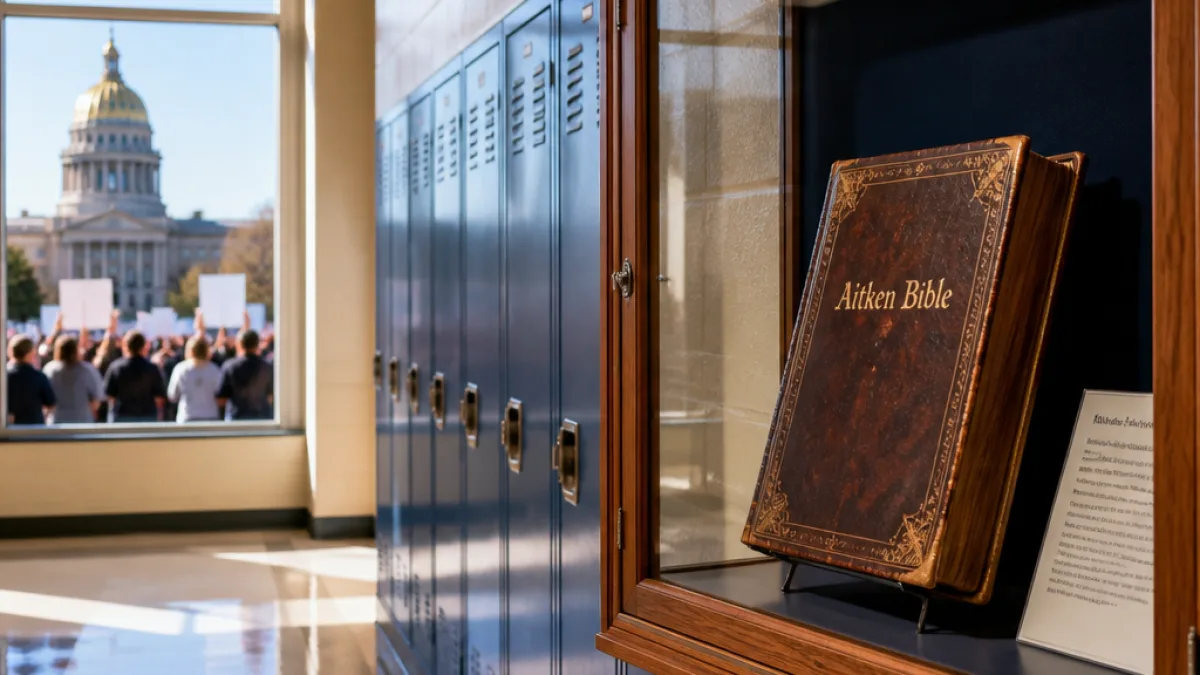
The West Virginia Senate this year approved a bill directing that the historic Aitken Bible be placed in public K-12 schools across the state, a move supporters call recognition of a historical document and critics say amounts to promoting religion in public classrooms.
The measure, sponsored by Sen. Amy Grady, R‑Mason, likens the Aitken Bible to other founding-era artifacts such as the Declaration of Independence. The action followed commentary in which Sen. Jack Woodrum, R‑Summers, described the Bible as “the foundational, American historical document presented during the Revolutionary era,” and said it is referenced in studies of early American culture, literacy and political thought.
“This Bible is the foundational, American historical document presented during the Revolutionary era, and it’s referenced in the study of early American culture, literacy and political thought.” — Sen. Jack Woodrum, R‑Summers
What would change for students and schools
If implemented, the law would require school districts to display the Aitken Bible in school buildings. For teachers and administrators, that creates new decisions about placement, signage and how—or whether—to incorporate the volume into classroom instruction about history or civics.
Supporters argue the Bible is an artifact that can illuminate colonial literacy and political thought. Opponents, including some civil liberties advocates and constitutional scholars, warn that government-directed religious displays in public schools can run afoul of the First Amendment’s prohibition on laws “respecting an establishment of religion.”
How the debate fits into broader national conversation
Nationally, the question of religion’s role in civic life has regained attention as political leaders and media discuss how the nation’s 250th anniversary should reflect religious history. Journalists such as Judy Woodruff on PBS have examined whether the United States was created as a Christian nation and aired perspectives from scholars with differing views.
Public opinion is mixed, according to a 2022 Pew Research Center survey cited by commentators. The poll found:
- Less than half of Americans say the country should be a Christian nation.
- 60% believe the Founding Fathers intended the United States to be a Christian nation.
- 83% say the Supreme Court should not decide cases based on justices’ personal religious views.
| Question | Result |
|---|---|
| Should the U.S. be a Christian nation? | Less than 50% |
| Do Founders intend a Christian nation? | 60% |
| Should SCOTUS decide based on religious views? | 83% say no |
Legal and practical considerations
Legal experts have long cautioned that mandated religious displays in public schools risk litigation under the First Amendment. The source material for the story notes broad public resistance to courts deciding cases on justices’ personal faith, underscoring the sensitivity of making religion an instrument of government policy.
For West Virginia families, the legislation may prompt school boards to adopt policies on display location, parental opt‑outs for any classroom discussions tied to the Bible, and guidance for teachers on treating the volume as a historical object rather than devotional material. The extent to which state education officials will provide implementation guidance was not specified in reporting on the bill.
Voices in the debate
Proponents in the Senate framed the Aitken Bible as part of early American culture and literacy. Critics argue that using state power to place a religious text in classrooms is inconsistent with constitutional church‑state separation. Scholars such as John Fea of the Lumen Center have been cited in national coverage laying out both historical interpretations of the Founders’ intent.
The legislation followed commentary in which West Virginia Watch criticized the state’s approach to K‑12 education and argued lawmakers were prioritizing symbolic religious displays over addressing systemic shortcomings.
As implementation moves forward, local school officials, parents and legal observers are likely to watch for administrative guidance, possible challenges in state or federal court and how classrooms handle any new displays.
Colton McRae is the West Virginia correspondent for News Block.