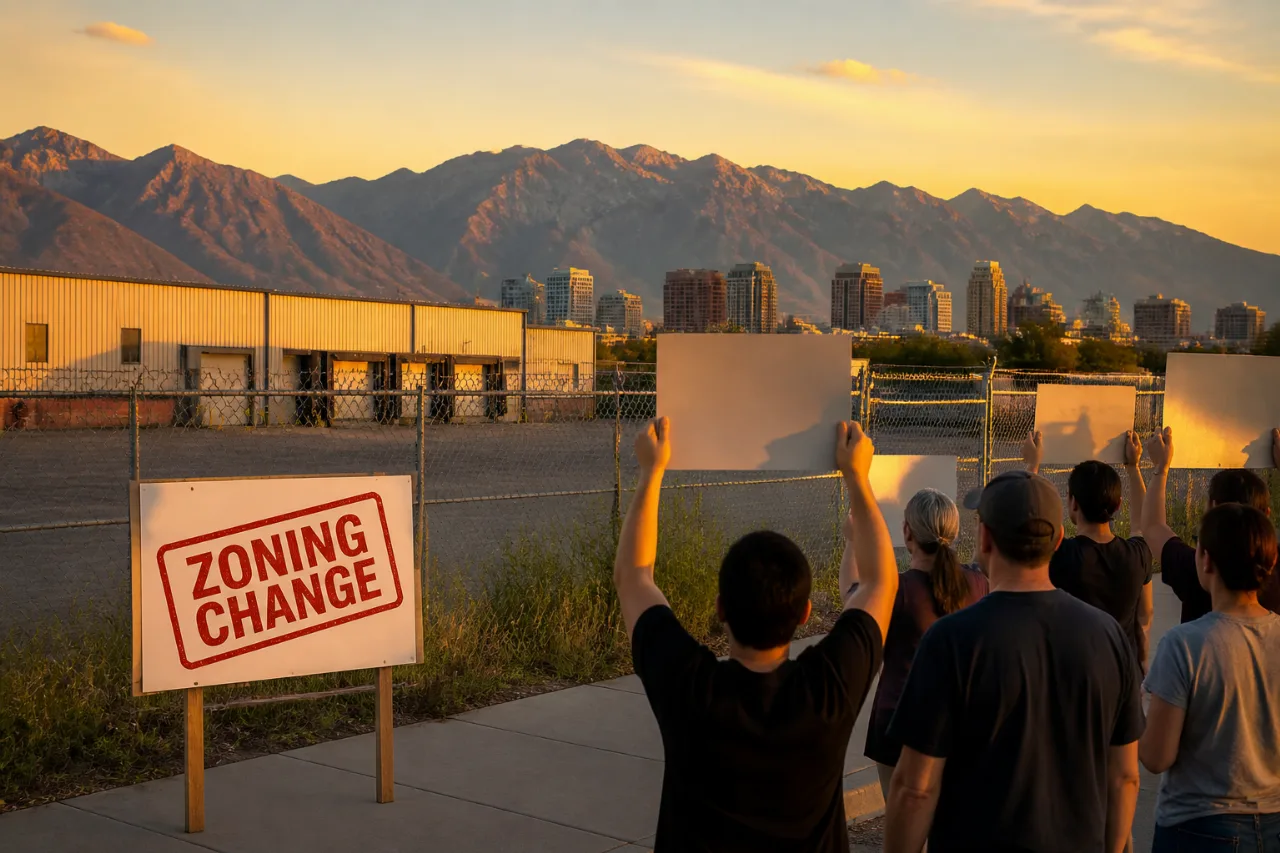
The Salt Lake City Planning Commission on Wednesday voted unanimously to favorably recommend a zoning text amendment that would remove jails and correctional facilities from the city's land-use tables, a move aimed at preventing a privately run immigration detention center from opening on the city's west side.
The change would apply to properties zoned M-1 (light manufacturing), MU-11 (mixed-use district 11) and public land, where jails and correctional facilities are currently listed as conditional uses. The amendment, if adopted by city leaders, would not affect state or federal land that is exempt from local zoning regulations.
What this means for residents
For Salt Lake City homeowners, workers and business owners near the west side site in question, the recommendation signals a new local barrier to the development of detention operations on private property, including facilities run by private companies under contract with federal agencies.
- Scope: The amendment targets private properties in M-1, MU-11 and public land zones.
- Limitations: It would not apply to land owned by state or federal entities that are not subject to local zoning.
- Process: The Planning Commission's recommendation must still be considered and approved by the City Council to take effect.
The measure was initiated by the Planning Commission in March, weeks after the Department of Homeland Security finalized its purchase of an 833,000-square-foot warehouse at 6020 W. 300 South for $145.44 million. Federal officials later acknowledged plans for an immigrant detention center that would house roughly 7,500 to 10,000 detainees, according to reporting cited by local officials.
"I don't feel like it's enough, but I don't think there's anything we could do that would be enough," said Lilah Rosenfield, a member of the city planning commission, reflecting on the debate that followed the proposed — and now, she said, hopefully tabled — ICE detention facility.
Legal and political backdrop
Salt Lake City and Salt Lake County filed suit against the Department of Homeland Security in June in the U.S. District Court of Utah challenging the federal agency's actions related to the warehouse purchase. A community group, Uproar Utah, affiliated with the Utah Refuge Justice League, filed a separate lawsuit the same month.
It remains unclear whether the ICE facility plan will move forward. The New York Times reported recently that DHS was seeking to divest several properties it had acquired — including the Salt Lake City warehouse — but Department of Homeland Security officials did not confirm or deny that report.
Next steps and implications
If the City Council adopts the Planning Commission's recommended zoning text amendment, private developers and contractors would no longer be able to pursue conditional-use permits for detention facilities in the affected zones within Salt Lake City. That would narrow the avenues available for a privately run immigration detention center on private land inside city limits, though federal or state projects on exempted land would remain outside local control.
| Element | Details |
|---|---|
| Warehouse address | 6020 W. 300 South |
| Size | 833,000 sq. ft. |
| Purchase price | $145.44 million |
| Planned capacity reported | 7,500–10,000 detainees |
The Planning Commission's recommendation represents another step in a highly visible local response to the federal purchase and proposed use. City residents should expect the City Council to take up the amendment in the weeks ahead; any final adoption would reshape where private detention facilities could legally locate within Salt Lake City.