
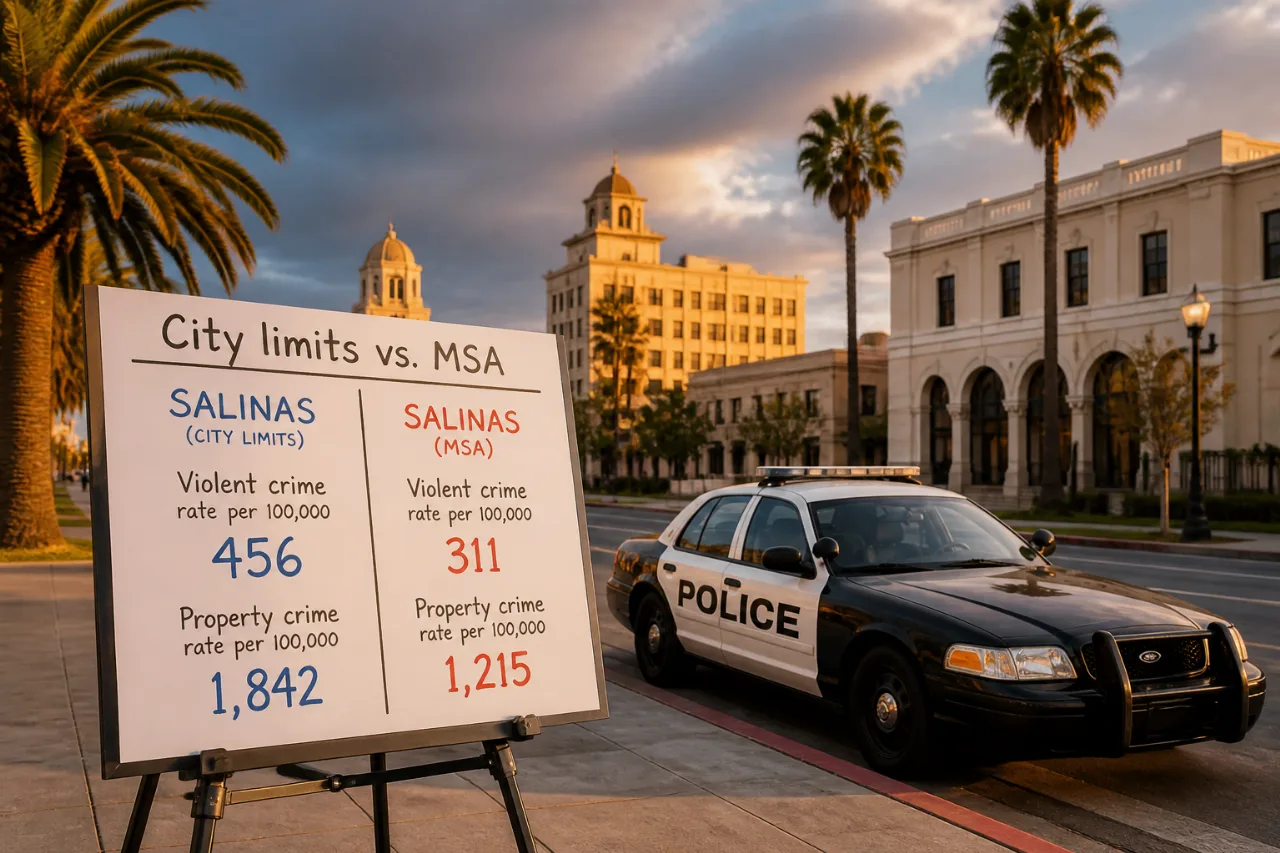
Salinas residents may see headlines placing the city near the top of statewide crime lists, but local police figures and how the region is defined change the narrative for people who live here.
What changed for Salinas residents
A report published by home security company Reolink ranks Salinas No. 8 among California cities with the highest crime rates, relying on 2023 FBI data and statewide comparisons. The company cited a violent crime rate of 6.53 per 1,000 residents, a property crime rate of 31.12 per 1,000 residents, and a vehicle-theft rate of 10.3 per 1,000 residents, noting a reported 14% year-over-year increase in auto thefts.
But the report does not make clear whether its figures apply to the city limits of Salinas or the broader Salinas metropolitan area — a distinction that matters for residents, elected officials and market observers.
City data vs. regional data
The U.S. Office of Management and Budget defines the Salinas Metropolitan Statistical Area as coterminous with Monterey County, encompassing more than 3,280 square miles and including coastal, inland and agricultural communities beyond the city of Salinas.
By contrast, the Salinas Police Department reports crimes that occur within city boundaries. Using the city population estimate of 160,779 from Census Reporter (2024 estimate), the department recorded the following Part I crime totals:
| Year | Part I crimes |
|---|---|
| 2023 | 1,719 |
| 2024 | 1,950 |
| 2025 | 1,774 |
Those city figures translate to roughly 493 Part I crimes per 100,000 residents in the most recent reporting, a metric that differs significantly from the per‑1,000 rates cited in the Reolink release.
Why the difference matters
- Geographic scope: Combining county or regional incidents with city-only counts can inflate or deflate a community’s apparent crime rate.
- Data sources and years: Reolink used FBI data from 2023; local police reports include subsequent years and may track different categories.
- Perception and policy: Rankings in national or statewide lists influence public perception, real estate decisions and pressure on local law enforcement and policymakers.
“Salinas ranked No. 8 on a list of California cities with the highest crime rates in a 2026 report published by home security company Reolink,”
The quote above reflects the Reolink conclusion. But local law enforcement emphasizes the importance of using city-specific data when assessing public safety inside Salinas.
Local consequences and next steps
For residents, the immediate consequence is how local crime reporting and national lists may affect daily life and long-term decisions, such as housing and business investment. City officials and the police department may cite the discrepancy when responding to the ranking and could press Reolink or similar outlets to clarify methodology and geographic scope.
For policymakers, the divergence highlights the need for transparent, comparable crime metrics and sustained communication with the public about trends — especially where agricultural-worker communities and vehicle thefts have been identified as contributing factors in broader regional assessments.
Officials or agencies seeking comment on the Reolink ranking and the city’s own data can expect residents to ask for clear explanations of which populations and geographies are being measured and why certain crime categories drive headline rankings.
Salinas residents should continue to follow official updates from the Salinas Police Department and county public safety agencies for the most accurate, jurisdiction-specific information.