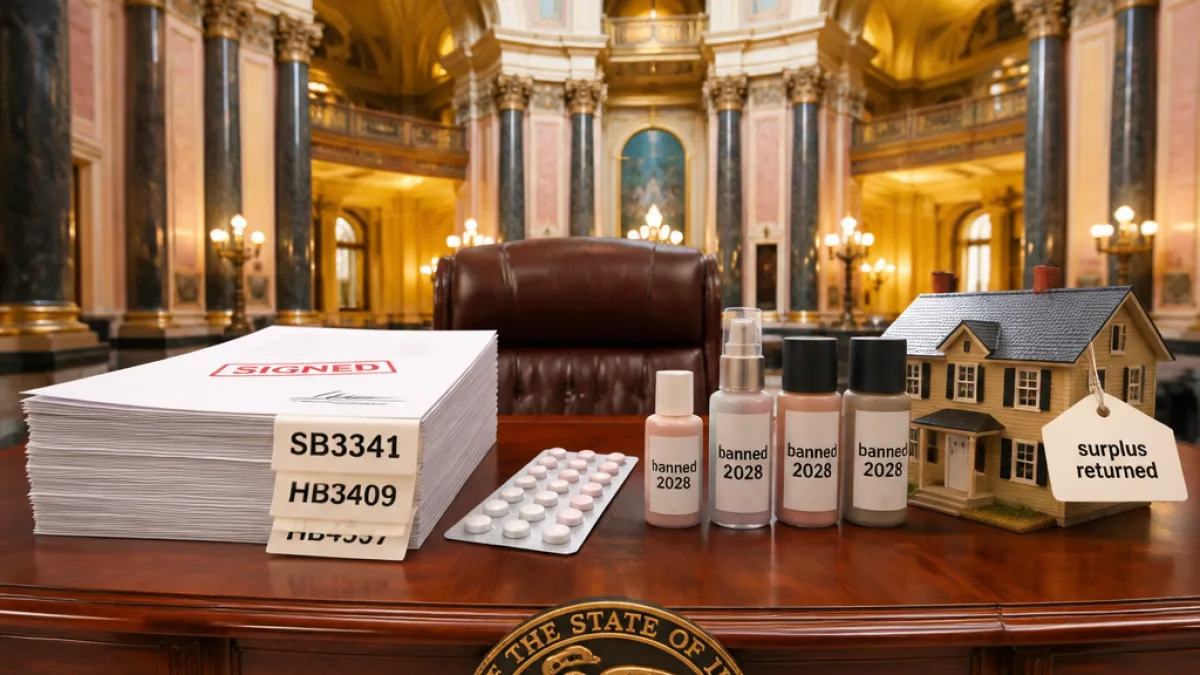
SPRINGFIELD — Gov. J.B. Pritzker on Friday signed 31 bills from the spring legislative session into law, advancing measures that expand reproductive access, restrict certain cosmetic chemicals and align Illinois property-tax procedures with a 2023 U.S. Supreme Court ruling.
Key changes affecting families, consumers and homeowners
Among the measures signed was Senate Bill 3341, which allows minors to receive birth control without parental permission. The new Illinois law brings the number of states permitting minors to access contraception without an adult’s consent to about half, according to legislative summaries. During debate, Republican lawmakers objected, arguing the change removes parents from important decisions and that minors might not fully grasp possible complications associated with birth control.
Another notable law, House Bill 3409, bans the manufacture and sale of cosmetic products that intentionally include 11 specified ingredients characterized as harmful substances or “forever chemicals.” The statute’s effective date is July 2028. The measure’s sponsor, Sen. Mattie Hunter of Chicago, framed the change as closing a regulatory gap.
“For too long, the cosmetics industry has operated without the kind of oversight we apply to food, medicine and drinking water,” Sen. Mattie Hunter said in a statement.
The cosmetics law mirrors restrictions already in place for many of the same substances in the European Union. State lawmakers and regulators, however, did not include penalties in the bill text for manufacturers or sellers who fail to comply.
Property-tax auctions and returning surplus funds
House Bill 4537 amends Illinois law to comply with the U.S. Supreme Court’s 2023 decision in Tyler v. Hennepin County. The ruling found it unlawful to retain surplus auction proceeds after a property was taken and sold over unpaid debts. Under the new Illinois law, when a property is seized and sold for unpaid debt, any surplus funds left over following the auction now must be returned to the former owner.
Illinois was the last state to bring its statutes into conformity with the Tyler decision. The legislation followed extended negotiations and a period in which Cook County postponed tax sales while lawmakers worked toward a long-term fix that the governor signed this week.
What’s in the package — at a glance
- 31 bills signed from the spring session.
- SB 3341: Minors may receive birth control without parental consent.
- HB 3409: Ban on 11 cosmetic ingredients; effective July 2028; no penalties specified in the bill.
- HB 4537: Requires return of surplus proceeds from tax-sale auctions to former owners, aligning state law with Tyler v. Hennepin County.
| Bill | Topic | Effective / Notes |
|---|---|---|
| SB 3341 | Minor access to birth control | Allows without parental permission |
| HB 3409 | Cosmetic ingredient ban (11 substances) | Effective July 2028; no penalties specified |
| HB 4537 | Property-tax auction surplus | Brings Illinois into compliance with 2023 Supreme Court decision |
Lawmakers described the package as part of the regular process of finalizing spring-session measures. Supporters emphasized consumer protection and ensuring property owners’ rights; critics raised concerns about parental authority and implementation details, particularly around enforcement and penalties for new consumer-safety requirements.
Residents directly affected by the property-tax change could see an administrative process established to identify and return surplus auction proceeds, while consumers and industry stakeholders will have more than two years to prepare for the cosmetics ban that takes effect in mid-2028. Health-care providers and clinics will need to adjust procedures to comply with the new rules on minor access to contraception.
As agencies and local governments implement these laws, additional guidance, administrative rules and procedures are expected to follow from state regulators and county offices charged with executing tax-sale processes.
Grace Kowalski is the Illinois correspondent at News Block.