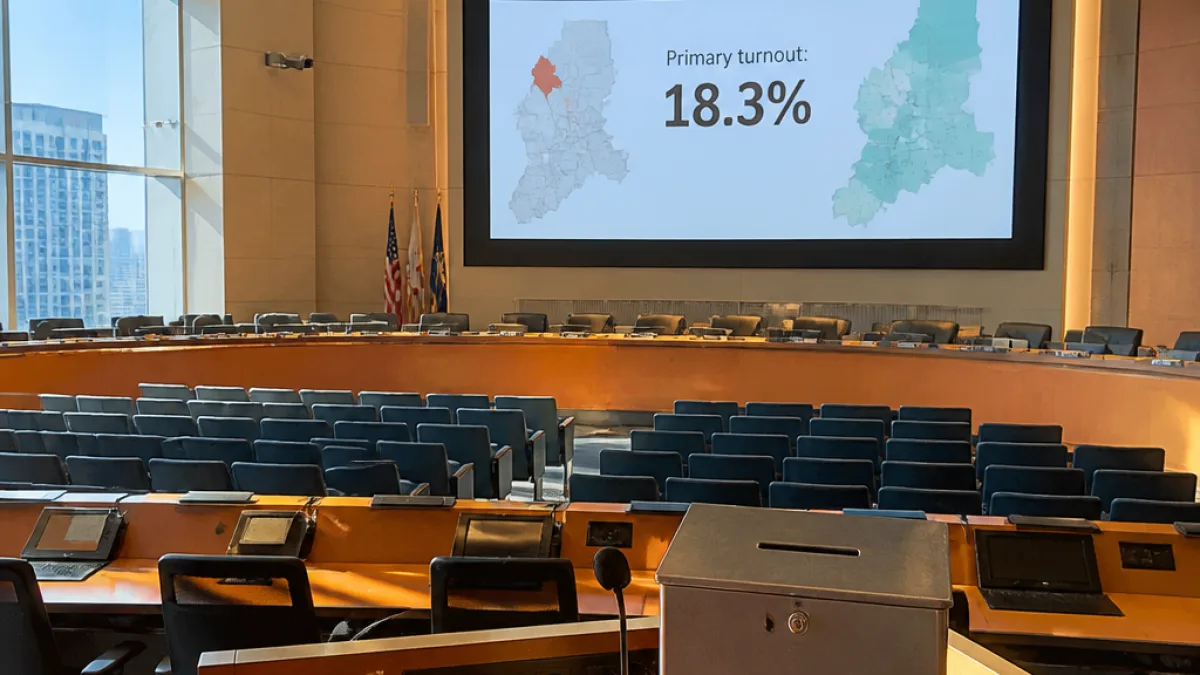
Local leaders and election officials in Nevada are grappling with a familiar, stubborn problem: too few voters showed up for the state's recent primary. Clark County — home to more than 1.5 million registered voters — reported an overall participation rate of 18.3%, while the statewide primary turnout was 21.8%.
Municipal concern after low participation
At a June 18 meeting during which the Las Vegas City Council moved to formally affirm last month’s primary results, Mayor Shelley Berkley voiced sharp disappointment at the participation figures presented by City Clerk LuAnn Holmes. Berkley noted that, despite an array of access measures — including universal mail ballots, early voting and numerous polling places — fewer than one in five registered Las Vegas voters cast ballots.
“Is there anything that we are missing here, that the city could be doing to encourage people to exercise the most sacred right of being an American citizen, and that is voting for your elected officials?”
Berkley and Holmes agreed to continue conversations about ways to boost participation in future elections.
Numbers and context
Clark County reported 1,511,315 registered voters for the primary. Within that pool, the county’s nonpartisan (independent) voters — now its largest single group — participated at a much lower rate of 6.4%. That contrast highlights a recurring pattern: turnout for primaries is far lower than in general elections.
| Measure | Value |
|---|---|
| Clark County registered voters | 1,511,315 |
| Clark County primary participation | 18.3% |
| Nevada statewide primary participation | 21.8% |
| Nonpartisan voter participation (Clark) | 6.4% |
Secretary of State Francisco Aguilar cautioned that Nevada’s voter rolls have grown since the state adopted automatic voter registration through a 2018 ballot measure, which affects turnout percentages. He also pointed to the contrast with general elections: turnout typically rises sharply when races are more competitive or coincide with national contests. For example, statewide participation in November general elections in 2008 and 2012 reached roughly 80%.
Experts point to structural and political factors
Political analysts and local observers have cited several drivers for low primary turnout: Nevada’s closed party primary system, areas with uncompetitive races, possible effects of gerrymandering that reduce incentives for competition, and broader political apathy. Over a longer arc, Nevada’s primary participation has ranged widely since 2002 — from a low of 16.2% in 2024 to a high of 30.1% in 2010.
Clark County’s worst recorded primary participation came in 2006, when just 13,186 voters cast ballots — a turnout of 2.1% — underscoring how low engagement in primaries can be in some cycles.
What this means locally
Low primary participation has practical implications: when relatively small numbers of voters decide nominations, elected officials may be chosen by a narrow slice of the electorate, potentially leaving large blocs — including independent voters — feeling unrepresented. That effect can also shape the policy agenda and the competitiveness of future races.
- Closed primaries can exclude independents from selecting party nominees.
- Automatic registration increases the denominator in turnout calculations, which can depress percentage turnout figures.
- Noncompetitive districts may reduce voters’ perceived influence on outcomes.
Local officials, including the mayor’s office, have signaled interest in exploring outreach and policy options to improve engagement. Any potential changes — such as adjustments to primary rules, more targeted voter education, or electoral reform aimed at increasing competition — would require careful study and, in some cases, legislative or ballot-action steps.
For residents tracking participation and future election plans, election officials continue to emphasize existing access measures: universal mail ballots, early voting windows and numerous polling locations across the valley remain available for both primaries and general elections.
As Nevada heads toward other election milestones, observers and local leaders will be watching whether efforts to address the causes behind low primary turnout can produce measurable gains in voter participation.