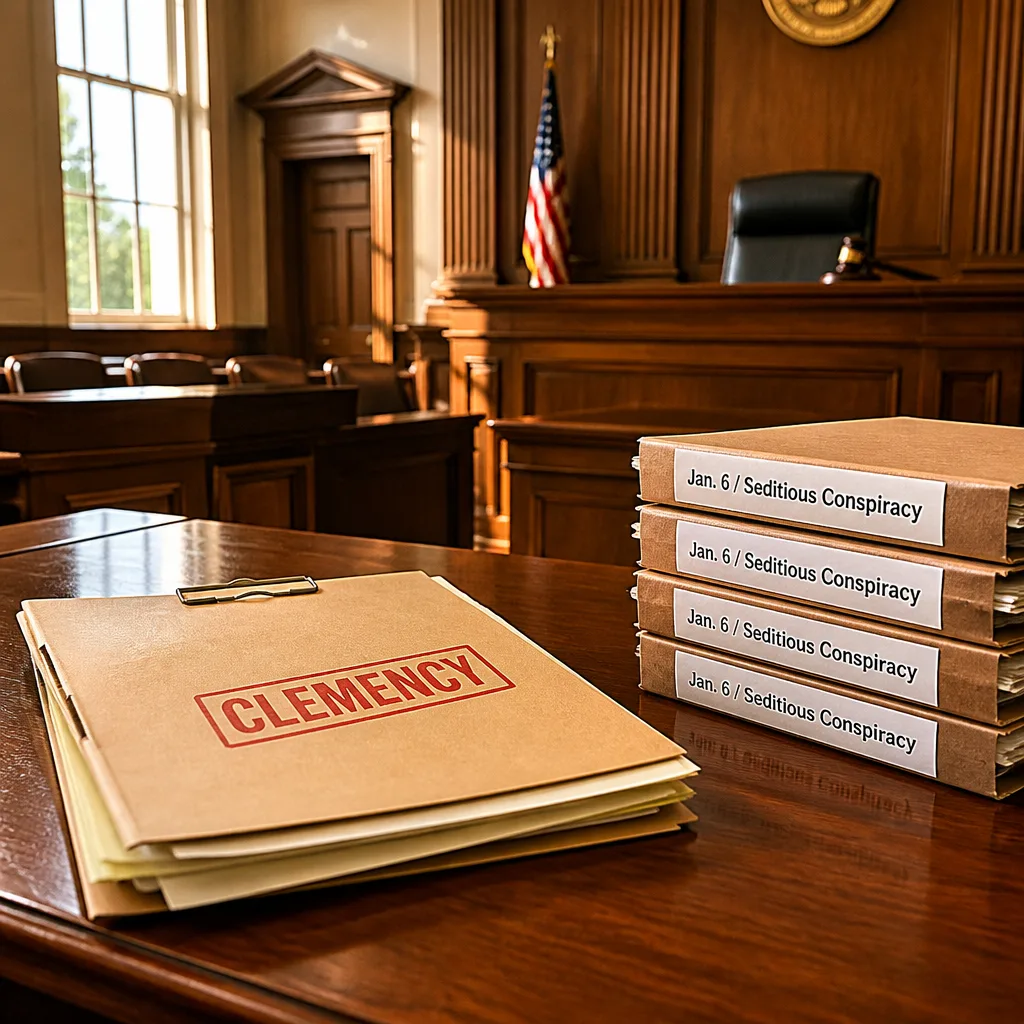
WASHINGTON — A federal judge has formally dismissed the remaining convictions in the government’s high-profile seditious-conspiracy case against leaders of the Proud Boys, concluding a legal outcome made unavoidable by President Donald Trump’s broad clemency last year that wiped out prosecutions tied to the Jan. 6, 2021, attack on the U.S. Capitol.
U.S. District Judge Timothy Kelly, a Trump appointee who presided over the trial of the Proud Boys’ leadership, said there was essentially no legal basis to sustain those convictions after the administration’s decision to extend mass clemency to participants in the Capitol riot. Kelly nonetheless emphasized that his order should not be read as endorsement of the Justice Department’s withdrawal from the Jan. 6 prosecutions.
“President Trump’s views about the prosecution of those who attacked the U.S. Capitol on January 6 — whether those views are based on fact or fiction — are well known, as is his intention to extend clemency to them,” Kelly wrote.
The judge described the Jan. 6 attack as “a perilous event” and an assault on the constitutional norm of peaceful transfer of power, language underscoring his continued recognition of the gravity of the conduct at issue even as the court was compelled to vacate convictions.
What the ruling means
Friday’s dismissal applied to four of the five Proud Boys members who had been convicted after a jury trial, including at least one named in court filings, Ethan Nordean. The decision follows the White House action last year that nullified the government’s prosecutions arising from the riot, effectively removing the legal foundation for preserving those jury verdicts.
- Clemency effect: The president’s pardon power eliminated ongoing Jan. 6 prosecutions, prompting judges to dismiss related convictions.
- Judicial stance: The presiding judge dissented from the policy choice but said the law required dismissal once clemency was granted.
- Broader cases: Juries previously convicted leaders of the Proud Boys and the Oath Keepers in separate trials for coordinated violent efforts to keep Trump in power; a different judge has yet to rule on the Oath Keepers’ related request for relief.
The federal trials against leaders of the Proud Boys and the antigovernment Oath Keepers had produced landmark guilty verdicts for seditious-conspiracy and other offenses, findings that prosecutors said demonstrated organized schemes to interfere with the peaceful transition after the 2020 election. With the Proud Boys convictions vacated, the federal landscape for Jan. 6 accountability has shifted sharply, though other legal and political avenues remain active.
| Group | Recent judicial action |
|---|---|
| Proud Boys | Remaining convictions dismissed following presidential clemency |
| Oath Keepers | Convictions remain; related judicial requests pending before another judge |
Kelly’s opinion explicitly acknowledged the political dimensions of the administration’s move while reiterating the court’s constrained role in reviewing a president’s exercise of clemency. He wrote that the second Trump administration’s decision to abandon the prosecutions was unsurprising given the president’s previously stated intentions.
The dismissal marks a significant turn in the post-Jan. 6 prosecutions that sought to hold extremist organizers and leaders accountable for coordination and violence at the Capitol. Legal experts and participants in the earlier trials have noted that the judicial findings documenting planning and violence had national implications for how political violence is investigated and prosecuted; those findings now face erosion in their practical effect as criminal judgments have been erased in some cases by the executive branch.
As the nation continues to consider the balance among executive clemency, accountability for political violence and the role of courts in preserving criminal judgments, the Proud Boys ruling illustrates how these constitutional and institutional tensions play out at the highest levels of government and the judiciary.