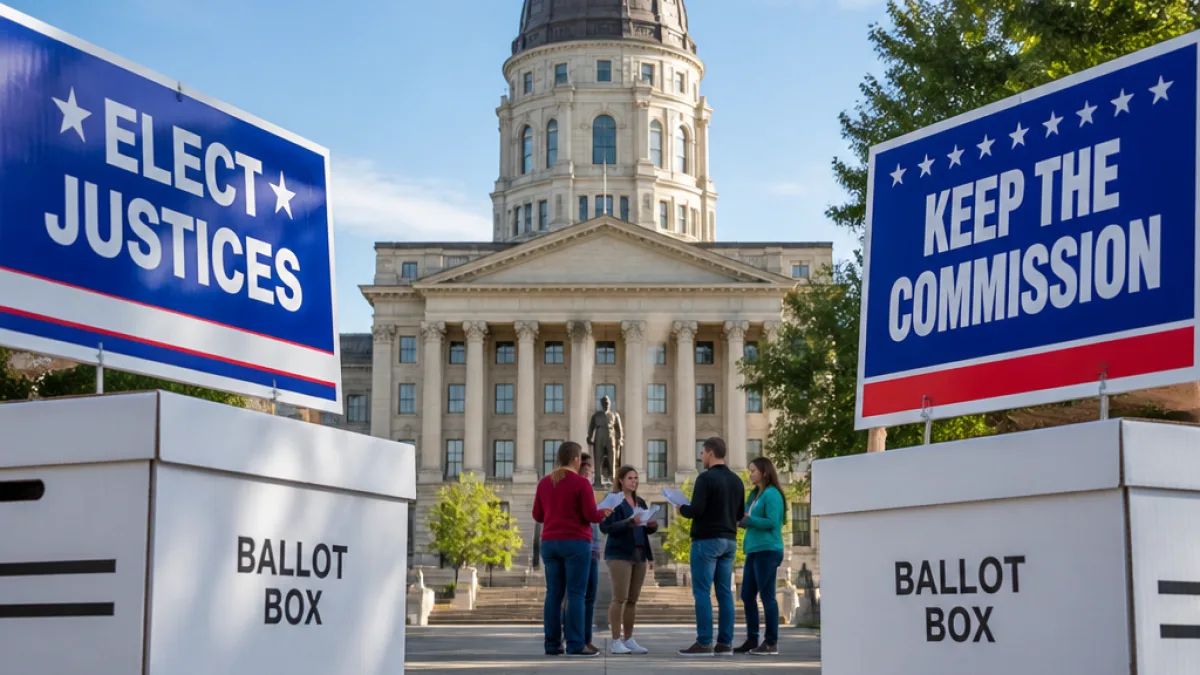
KANSAS — Voters in Kansas will decide this primary whether to alter the way the state’s highest court is filled, a change that would replace the long-standing commission and gubernatorial appointment process with statewide elections for Supreme Court justices.
What would change for residents
If approved, the amendment would require justices to run in statewide elections and serve six-year terms. The current process, in place since 1958, uses a nine-member nominating commission to vet candidates and forward a shortlist to the governor, who then appoints a justice.
The amendment’s backers argue elections return power to voters. Opponents contend the shift would inject partisan politics and campaign money into judicial races, potentially influencing decisions on contentious issues that affect everyday Kansans, including reproductive rights and school funding.
How selection works now — and how it would work
| Current system | Proposed amendment | |
|---|---|---|
| Method | Nominating commission screens candidates; governor appoints | Statewide election for justices |
| Term | Appointed until mandatory retirement or retention processes | Six-year elected terms |
| In place since | 1958 (approved after a state judicial scandal) | Would require voter approval to change the state constitution |
Arguments from both sides
- Supporters — including many Republican leaders statewide — say electing justices restores voter control and accountability over the judiciary.
- Opponents — legal observers, some public interest groups and other critics — warn elections would politicize the bench, open judicial races to campaign contributions and outside influence, and could alter rulings on major policy issues.
The current appointment process was adopted by Kansas voters in 1958 after a scandal known at the time as the "Triple Play," which prompted support for a vetted, merit-based system to keep politics out of judicial selection.
Organizers on both sides cast the choice as fundamental. Supporters frame it as expanding democratic input; opponents say the present system focuses on qualifications and impartial decision-making and should remain in place.
What residents should know now
The amendment will appear on the primary ballot. A yes vote would enact the change to elected justices with six-year terms. A no vote would preserve the current commission-and-appointment system.
For Kansans considering the issue, the decision carries consequences for how future rulings are made on statewide matters and how quickly the composition of the court could shift in response to electoral pressures.
Reporting for this article is based on recent coverage of the amendment and historical context of the judicial selection system in Kansas.