Oklahoma City Mayor David Holt is urging his city and neighboring suburbs to back an ambitious transit blueprint that would add commuter rail, light rail and expanded bus rapid transit (BRT) to a region long built around the automobile.
What the plan proposes
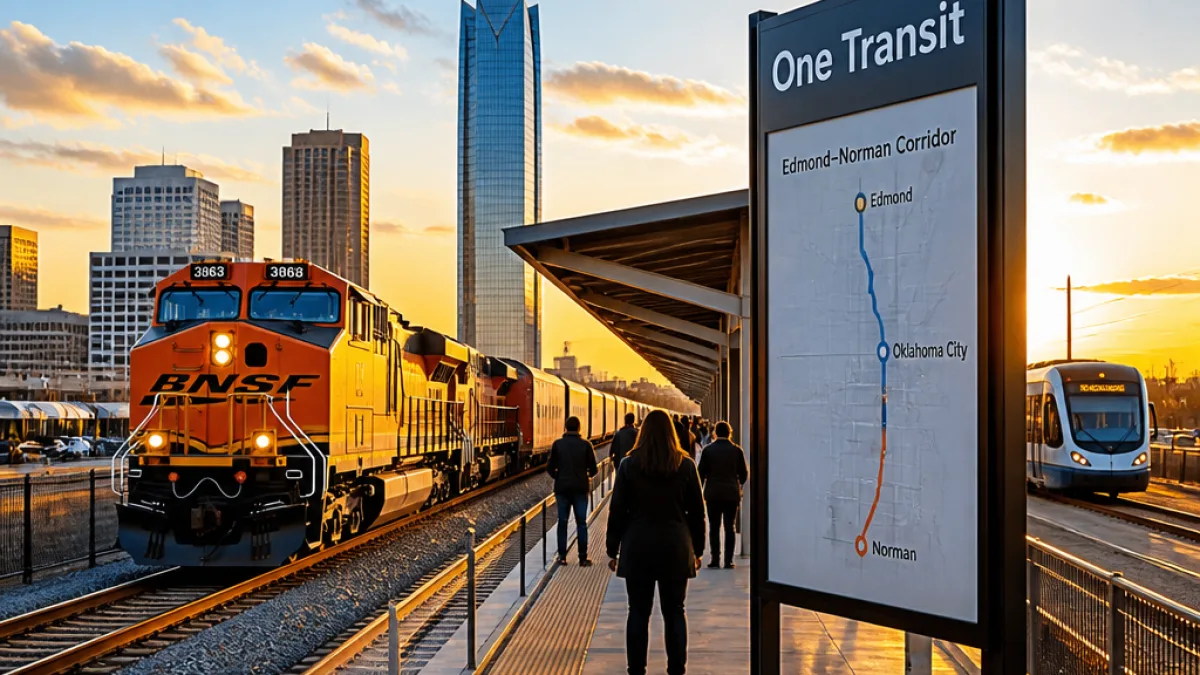
The initiative, promoted by the One Transit board (formerly the Regional Transportation Authority of Central Oklahoma), centers on a 39-mile commuter rail corridor connecting Edmond and Norman through downtown Oklahoma City. That rail line would use an existing BNSF right-of-way and be paired with light rail service to Will Rogers International Airport and an intermodal hub in the downtown core to link modes.
| Feature | Detail |
|---|---|
| Commuter rail length | 39 miles |
| Stations | 10 stations + 1 special-event stop |
| Estimated capital cost | $700 million–$800 million |
| Federal share | Approximately half |
One Transit projects peak hourly capacity of up to 2,400 riders in each direction on the commuter rail line. Backers say the package would create a regional spine that coordinates frequent service across modes.
Mayor frames plan as urgent
In his July 15 state of the city address, Holt warned that population growth is outpacing the city's ability to move people efficiently and argued immediate action is needed.
"The time to act was yesterday. The growth is passing us by. … Our ability to move freely around our city is in jeopardy and we need to act with urgency."
Holt noted that city population doubled since 1970 and cited projections from earlier decades showing substantial growth between 2000 and 2030, with a possibility the metro surpasses one million residents by 2055.
Local performance and next steps
Supporters point to early successes with bus rapid transit as evidence that demand exists. The Northwest BRT line, which began operations in December 2023, reportedly exceeded 1 million riders earlier this year, a performance item Holt highlighted as an example of how accessible, frequent service can attract customers.
Advancing the One Transit plan would require approval by the jurisdictions along the proposed corridor — Oklahoma City, Edmond and Norman — and then a public funding vote. Local reports indicate that could come within the next year if officials move forward.
- Plan relies on existing freight rail alignment for commuter service.
- Capital cost estimate: $700M–$800M, with federal funding expected to cover roughly half.
- Would require intergovernmental approvals and voter-backed funding measures.
The proposal refocuses long-running debates about growth, land use and transportation in a metro where driving remains dominant. Implementation would reshape regional transit options but hinges on cooperation among three city governments and on voter willingness to finance construction and operations.
Coverage of the One Transit plan and local reaction will be closely watched as officials consider whether to place funding measures before voters in the coming year.