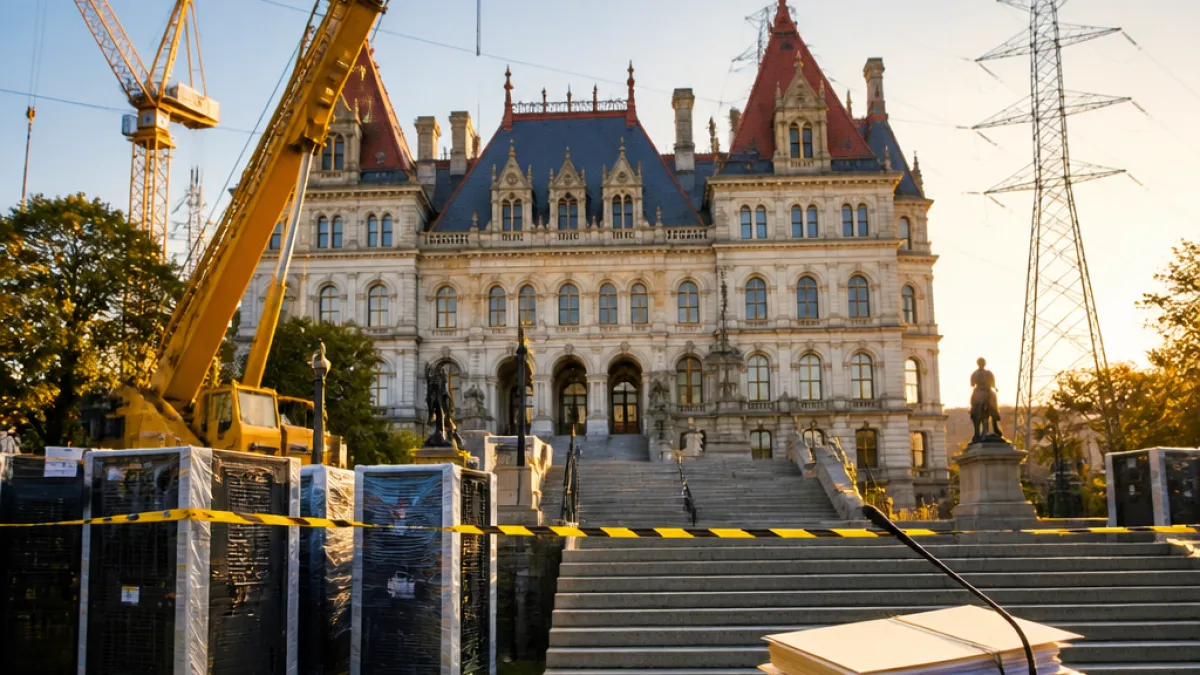
Gov. Kathy Hochul on Tuesday signed an executive order placing a temporary hold on certain state permits for very large data centers — a move aimed at steering how the state manages new electricity demand, water use and community impacts tied to expanding artificial intelligence infrastructure.
What the order does
The directive tells the New York Department of Environmental Conservation to pause processing discretionary state permit applications for construction or expansion of data centers that would consume 50 megawatts (MW) or more, unless the applications were already considered complete when the order took effect. The pause will remain in place until the state finishes a Generic Environmental Impact Statement or for one year, whichever comes first. Local permits issued by towns, counties or cities are not affected by the state pause.
Why Albany acted
New York officials said the halt responds to a rapid spike in proposed data-center projects seeking grid connections. State filings show nearly 12 gigawatts (GW) of requests were in the New York Independent System Operator interconnection queue as of May, including more than 8 GW that entered during 2025 alone. Lawmakers and regulators want to examine how concentrated, large power draws might affect the electric system and local environments as artificial intelligence demand grows.
How regulators will proceed
Rather than create a wholly new process, the governor expanded an ongoing Public Service Commission proceeding on large-load interconnection reforms. Under that docket, the Department of Public Service will prepare the Generic Environmental Impact Statement to evaluate issues such as:
- electricity demand and transmission impacts;
- freshwater use and water-quality concerns;
- air quality, noise and other environmental effects;
- disparate impacts on disadvantaged communities.
The executive order also requires Empire State Development to produce a Community Investment Framework within 60 days to help local governments negotiate and structure community benefits agreements with developers. That guidance is expected to address options including community investment funds, infrastructure improvements, workforce-development commitments and transparency measures.
Potential financial tools and local implications
State agencies were additionally directed to study a possible New York Grid Acceleration Fund. The fund could — if established by regulators or statute — require developers of large data centers to make upfront contributions to support grid upgrades or community investments, rather than shifting costs to other customers or local governments.
| Figure | Amount |
|---|---|
| Trigger threshold for pause | 50 MW |
| Interconnection queue total (May) | ~12 GW |
| Capacity entering queue in 2025 | >8 GW |
| Maximum length of permit pause | 1 year |
Local officials and community groups will still be able to review and act on municipal permits for new facilities, but state-level environmental reviews and utility interconnection approvals for the largest projects will be placed on hold while the state completes its analysis.
What this means for communities and developers
For communities hosting proposed projects, the pause creates time for state agencies to set clearer expectations around water withdrawals, emissions controls and community benefits. For developers, it introduces a period of regulatory uncertainty for very large projects that could require additional upfront mitigation or contributions if the state adopts new guardrails.
Officials have framed the step as precautionary: ensuring that a rapid influx of large-scale data-center proposals does not outpace planning for the electric grid and local environmental protections. The PSC case opened to examine these questions will determine how and when projects above the 50 MW threshold can move forward under any new statewide requirements.
As New York continues to court technology investment, the state’s approach will likely serve as a model for other jurisdictions wrestling with the same tension between economic development and the infrastructure and community costs of large data-center deployments.