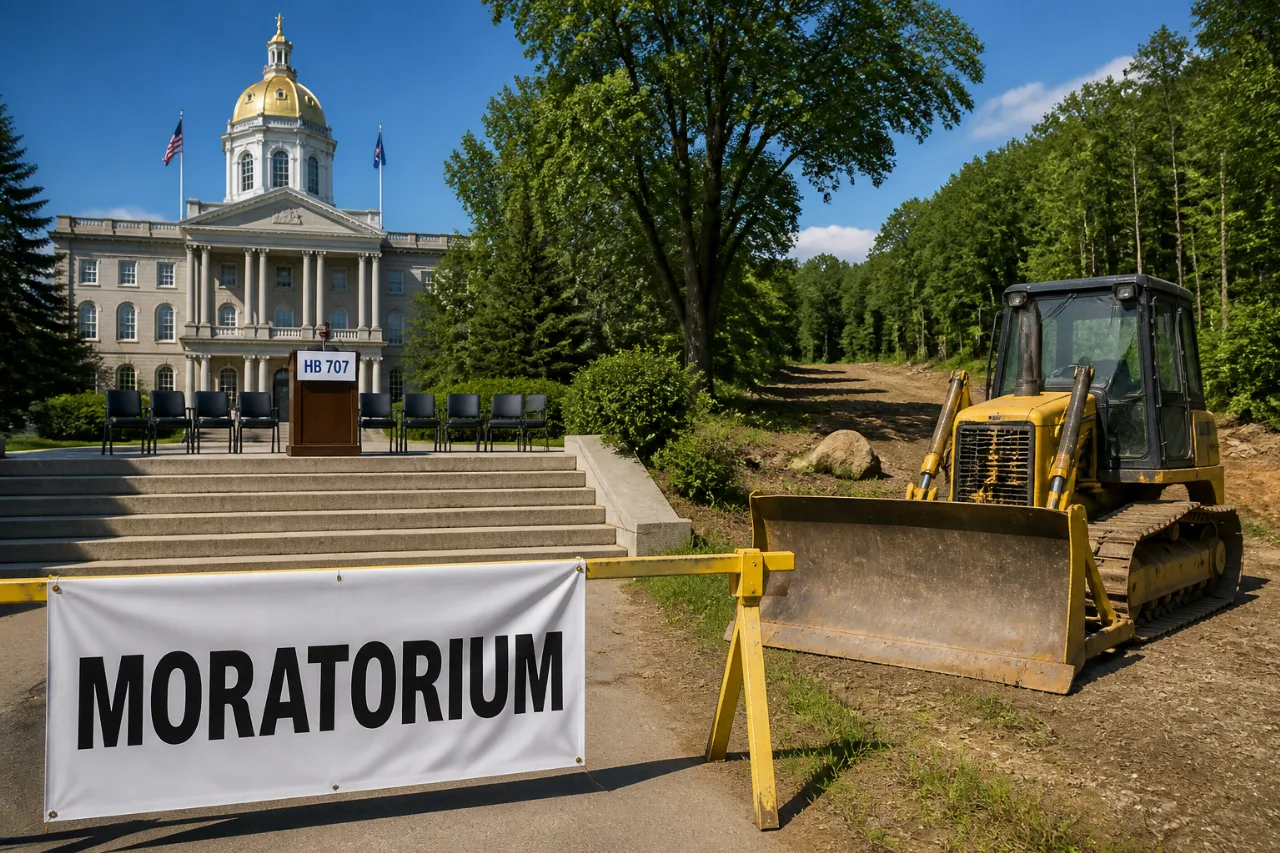
Gov. Kelly Ayotte on Friday signed House Bill 707, a measure that alters how New Hampshire will evaluate proposals for new landfills and expansions and places a temporary pause on new landfill capacity until at least July 1, 2027 or until the newly created evaluation committee adopts rules.
What the new law does
Under HB 707, a seven‑member site evaluation committee will review proposed landfill projects using broader criteria than have typically guided siting decisions in the state. Those criteria explicitly include potential impacts on:
- Human health
- The environment
- The local economy
- Scenery
The committee is structured to combine state agency expertise with gubernatorial appointments. Three seats are reserved for officials — or their designees — from the New Hampshire Waste Management Council, the Department of Business and Economic Affairs, and the Department of Environmental Services. The governor will appoint the remaining four members.
| Committee composition | Seats |
|---|---|
| State officials (or designees) | 3 |
| Governor appointments | 4 |
| Total | 7 |
Where this came from
The law follows more than a year and a half of debate in the Legislature over how New Hampshire should regulate solid waste and where new landfill capacity should be allowed. Ayotte had pushed for a version of this review process during her campaign, citing concerns raised during discussions about a proposed landfill near Dalton’s Forest Lake.
Throughout the 2025 and 2026 sessions lawmakers wrestled with the committee’s makeup and charge. Proposals moved back and forth between the House and Senate and several versions were amended before the final agreement that Ayotte signed. Lawmakers spent significant time arguing over the balance between statewide standards and local control; earlier drafts prompted concerns in the North Country that towns would be sidelined.
Local control and next steps
Supporters of the final bill say the expanded evaluation criteria will let decisionmakers weigh community values and environmental protection alongside economic considerations. Critics had warned that a centralized process could undercut local input; an amended version of the bill introduced late in the session, and shepherded in the Senate, was received more favorably by skeptics.
With the pause on landfill proposals now law, project proponents will be unable to advance new capacity plans until the committee has established its rules or the July 2027 deadline arrives. That gives the state time to develop a regulatory framework intended to be more comprehensive than past siting reviews.
For residents and local officials, the change means landfill controversies that were already contentious will now be considered under fresh standards. Municipal leaders and developers should expect rule‑making activity by the new committee in the months ahead; the law assigns the committee the task of adopting rules that will govern future siting evaluations.