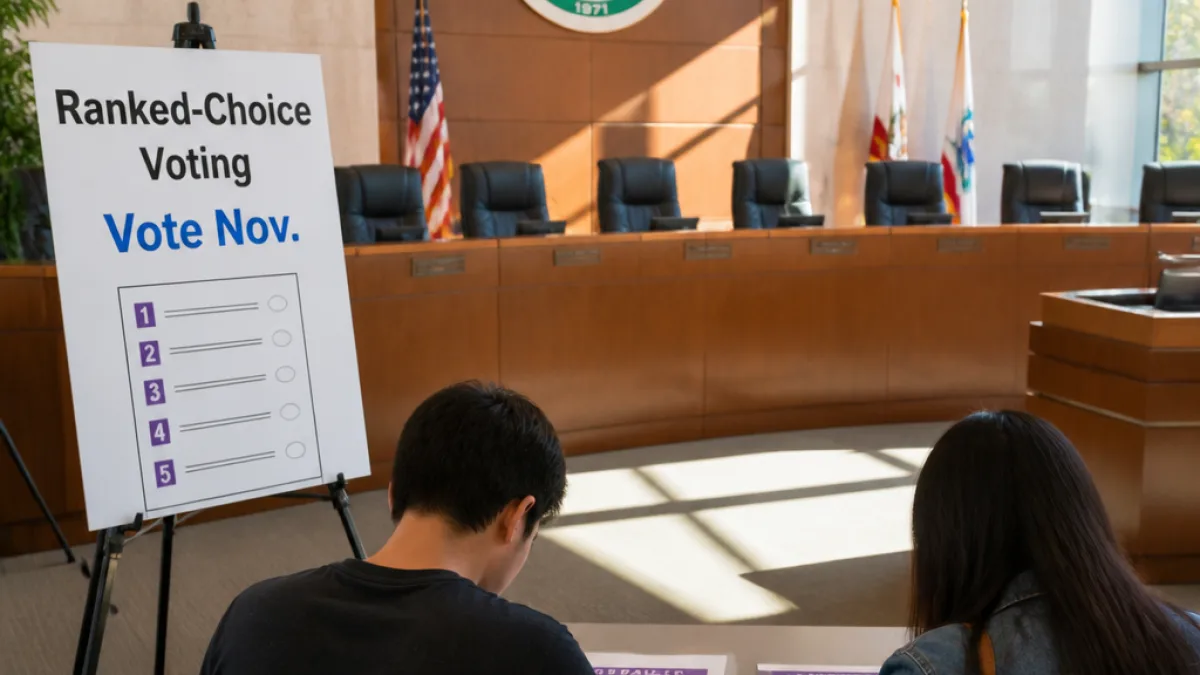
The Irvine City Council has placed a measure on the November ballot asking residents whether the city should adopt ranked-choice voting for future local elections, a change that would reshape how Irvine voters select their representatives if approved.
The 3-3 split council vote on July 14 means the decision will rest with the electorate. Under the measure, ranked-choice voting would be implemented by 2028 if voters approve it.
Supporters on the council — Councilmembers Betty Martinez Franco, Kathleen Treseder and Melina Liu, with the eventual support of Councilmember William Go — argued the system would address the so-called "spoiler effect," encourage more civil campaigning and reduce negative messaging.
“This is something that will fundamentally change the way Irvine residents choose their representatives, and the decision to adopt it belongs to the voters,” Melina Liu said. “My personal opinion doesn’t matter at that point because it is up to the voters.”
What changes for voters
If the ballot measure passes, voters would rank candidates in order of preference rather than choosing a single candidate. A winning candidate would need to receive at least half of the votes through the instant-runoff counting method used in ranked-choice systems.
- Timeline: Implementation targeted by 2028.
- How it works: Voters rank choices; ballots are reallocated until a candidate reaches 50% plus one.
- Potential benefits: Less vote splitting, reduced negative campaigning.
Council debate and objections
Mayor Larry Agran and Councilmembers James Mai and Mike Carroll opposed putting the measure on the ballot, citing unanswered questions about potential costs to taxpayers and the possibility of voter confusion. The dissenting members also noted that ranked-choice voting has not yet been used in Orange County municipal elections.
Ranked-choice voting is already used in at least nine charter cities in California, including Berkeley, Oakland and San Francisco. Elsewhere in Orange County, an Orange County Superior Court judge has tentatively ordered Huntington Beach to implement ranked-choice voting for the November general election as part of a legal remedy to address at-large voting concerns; that ruling is being challenged by the city.
Local context and next steps
Placing the measure before voters shifts responsibility for the policy change from the council to the electorate. If approved, the city will need to plan for voter education, administrative changes to ballot design and vote counting, and any associated costs. If rejected, Irvine will retain its traditional single-choice voting method.
| Supporters on council | Opponents on council | Implementation target |
|---|---|---|
| Martinez Franco, Treseder, Liu, Go | Agran, Mai, Carroll | By 2028 if approved |
Voters will see the measure on the November ballot. The campaign that follows is likely to focus on costs, voter clarity and comparisons with other California cities that already use ranked-choice systems. County election officials will be responsible for administering the vote and for any necessary voter outreach if the measure passes.
This decision marks a significant moment in Irvine's election policy, transferring the final call on whether to adopt a new voting system to the city's voters.