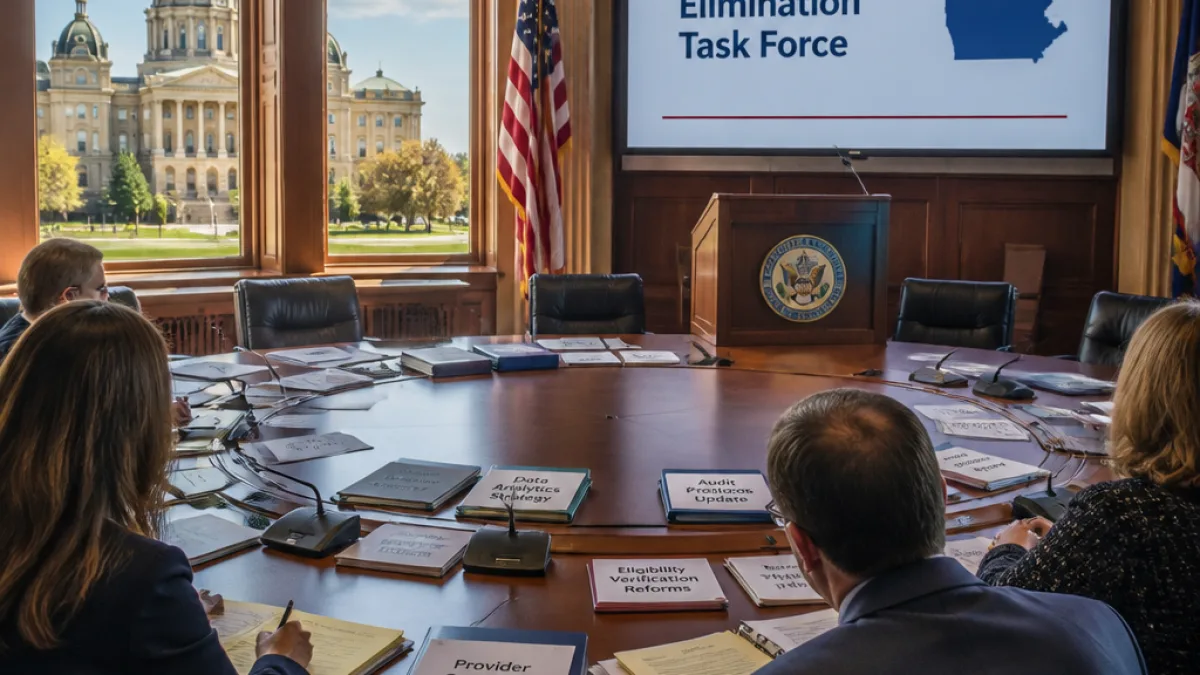
Attorney General Brenna Bird convened Iowa’s newly formed Medicaid Fraud Elimination Task Force for its first meeting Wednesday, launching a months-long effort to identify ways to reduce improper payments and hold providers accountable for fraudulent claims.
New team, focused mandate
The 11-member panel, created by Gov. Kim Reynolds through an executive order effective July 1, has been charged with producing a final report and recommendations to the governor by Oct. 29. Bird told members the group’s work should be aimed squarely at preventing and remedying payments that don’t belong in the taxpayer-funded program.
Bird framed the effort as a coordinated approach that pairs research and analysis with practical solutions for investigation, prosecution and civil recovery of erroneous Medicaid payments. She said the task force will rely on five working groups established at the inaugural meeting to carry out that work.
“There is no acceptable amount of Medicaid fraud,”
Bird said, emphasizing that providers who break the law must face consequences in both criminal and civil courts. She added that fraud drains resources intended to serve Iowans who rely on Medicaid.
How this fits with federal efforts and recent data
Iowa’s initiative aligns with recent federal measures aimed at curbing Medicaid improper payments, including a national task force led by Vice President J.D. Vance and provisions in the Republican-backed reconciliation package known colloquially as the “One Big Beautiful Bill.” One provision in that legislation would require states to shoulder the cost of erroneous Medicaid payments if their average error rates exceed a defined threshold.
| Item | Detail |
|---|---|
| Task force size | 11 members |
| Executive order effective | July 1 |
| Final report due | Oct. 29 |
| Latest projected improper payment rate (CMS) | 1.9% |
The federal Centers for Medicare & Medicaid Services most recently estimated Iowa’s projected improper payment rate at 1.9%. State officials will likely keep that figure in mind as they weigh both prevention and recovery strategies.
Who’s at the table
Alongside Bird, the task force includes state and private-sector representatives intended to provide a range of perspectives. The roster includes senior staff from Iowa Health and Human Services and health-plan executives. Bird described the five working groups as the “engine” that will drive the research and problem-solving that inform the final recommendations.
- Focus on prevention: stop improper payments before they occur.
- Investigations and prosecutions: set standards and procedures to pursue criminal and civil cases.
- Civil recovery: strengthen systems to recoup erroneous payments to providers.
The task force’s work comes at a time when states face increased federal scrutiny and potential financial incentives to reduce improper payments. How aggressively Iowa pursues recovery and how it balances enforcement with access to care will be central policy questions in the months ahead.
Members will now begin meeting in their working groups to research issues, analyze state data and draft recommendations. Those proposals will be compiled into the task force’s final report due to the governor on Oct. 29.