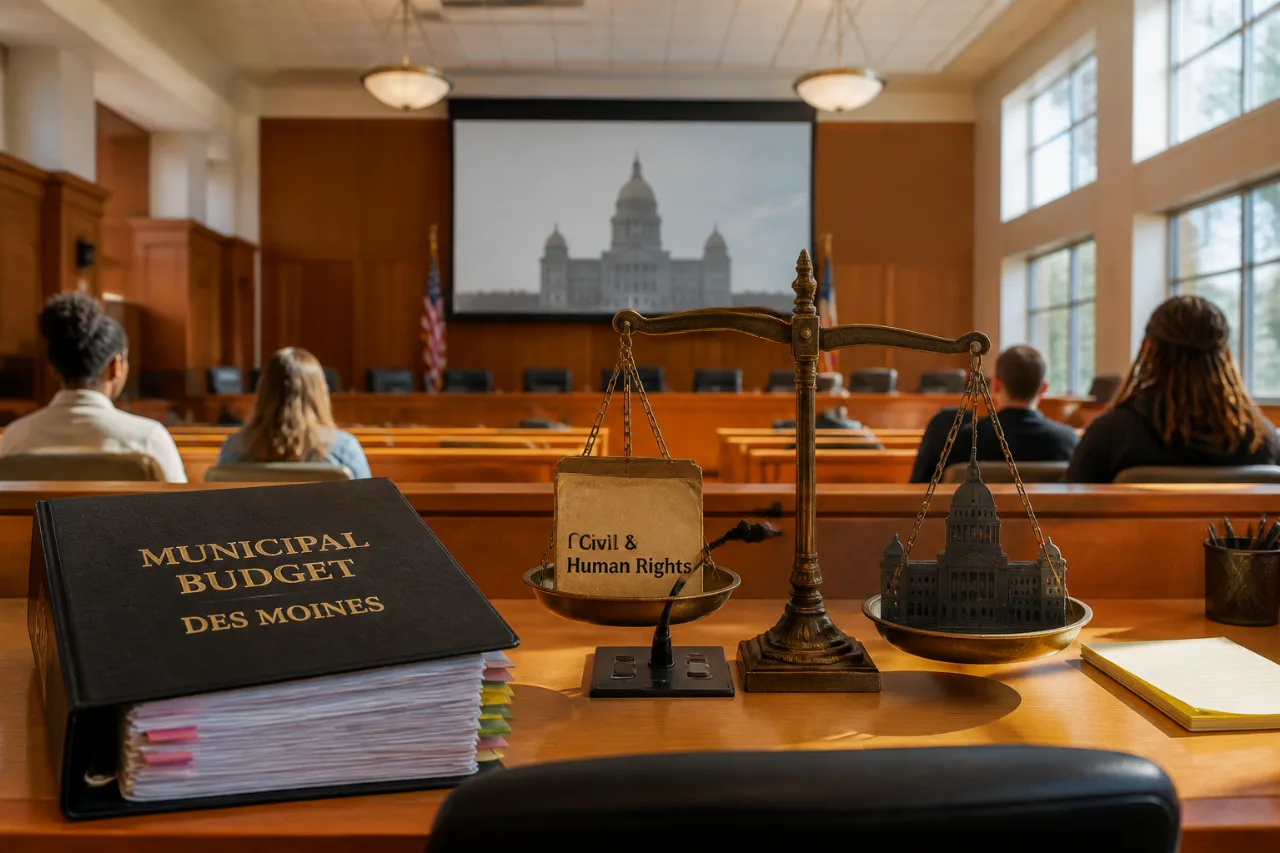
The City of Des Moines is weighing whether to scale back its local civil rights enforcement capacity as budget planning for 2028 begins, a debate that could reshape how discrimination complaints are handled for city residents.
Local office vs. state agency
City Manager Scott Sanders, during recent presentations to City Impact and Relations, suggested the city limit its local role and rely on the Iowa Office of Civil Rights to investigate complaints. That recommendation comes amid predictions of lean fiscal years ahead, but opponents warn the change would reduce access to timely, well-funded local investigations.
Data cited in the debate show a sharp difference in scale and funding between the two agencies:
- Iowa Office of Civil Rights: processes about 1,500 complaints annually with a state appropriation of roughly $1.3 million.
- Des Moines City Impact and Relations: completes about 20–35 complaints a year with an annual budget of $310,000.
| Agency | Annual complaints | Budget | Population served |
|---|---|---|---|
| Iowa Office of Civil Rights | ~1,500 | ~$1.3 million | ~3 million (state) |
| Des Moines City Impact and Relations | 20–35 | $310,000 | ~212,000 (city) |
What cutting local capacity would mean
Supporters of maintaining the city office say residents using Des Moines’ local resource effectively receive greater investigative support per complaint — roughly 8 to 16 times more funding behind each case than if routed through the state office, based on per-complaint funding comparisons presented to city leaders.
“In an attempt to recoup short-term costs, we are eating our own seed corn if we cut our city’s ability to investigate discrimination,” wrote Anthony J. Zarzycki, an appointed, volunteer Des Moines Civil and Human Rights Commissioner.
Critics of relying solely on the state agency point to broader political and legislative shifts in Iowa in recent years. The opinion piece notes actions by the governor and Legislature that removed some protected classes from the Iowa Civil Rights Act, curtailed certain displays at the State Capitol, restricted school library materials and pre-empted local governments from expanding civil-rights protections. The recent passage of Senate File 579 is cited as an example of that pre-emption, after Des Moines had adopted protections for gender identity and source of income.
Local consequences and context
For many Des Moines residents, the choice is practical: preserve a local office that handles a small number of cases but with greater attention and resources per complaint, or funnel complaints into a state system that handles a far larger caseload with far less funding per case. Advocates including the NAACP and editorial voices have signaled concern that the state office is less likely to find discrimination and may be stacked against complainants.
City budget decisions now under discussion could determine whether Des Moines keeps a dedicated mechanism to investigate discrimination complaints or shifts responsibility entirely to the state. The debate ties local service levels to broader statewide policy trends and raises questions about access to justice for residents who say they have faced discrimination.
As the 2028 budget process proceeds, residents and advocacy groups are expected to weigh in during public forums and council discussions. The outcome will shape how Des Moines handles civil-rights enforcement for the foreseeable future.